
Outbound Dialing Benchmarks 2026: Is Your Team Behind?
Real 2026 outbound dialing benchmarks for insurance agents: answer rate, contact rate, dials-per-quote, and where good operations separate from average.
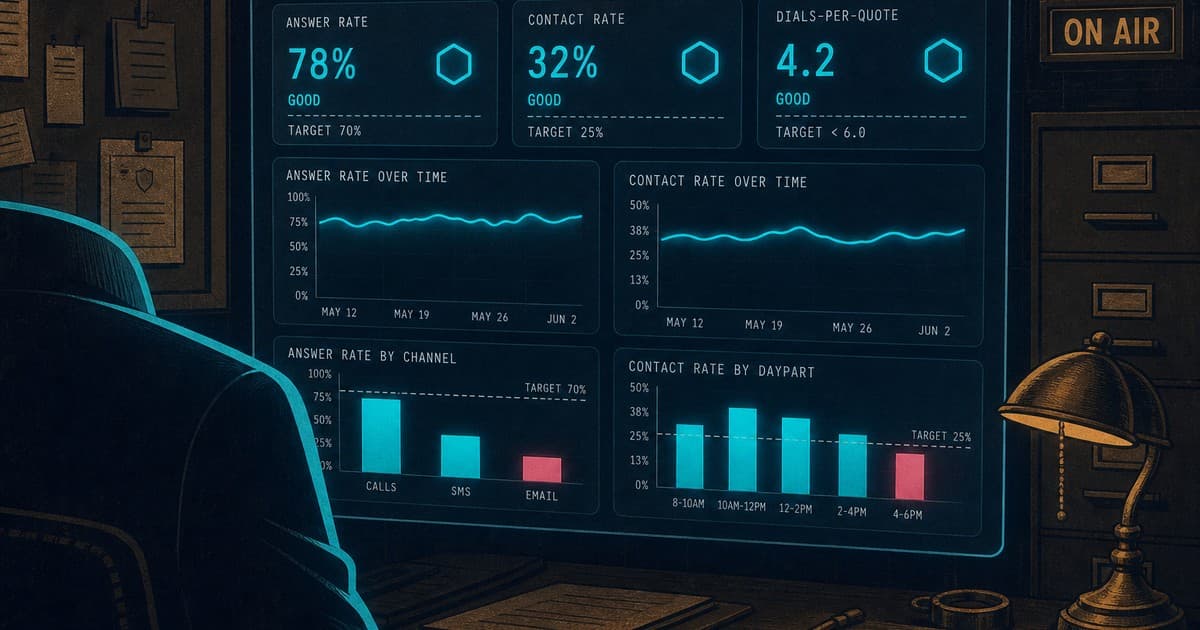
These benchmarks draw on publicly available dialer platform reports, carrier analytics summaries from Hiya and TNS, and patterns we see repeatedly across agencies running LineShield.
What does a healthy outbound funnel look like in 2026?
A healthy outbound funnel for insurance lead lists (aged under 30 days, P&C or final expense):
| Stage | Healthy Range | Common Problem Range |
|---|---|---|
| Dial to ring | 92-98% | Below 90% suggests telco issues |
| Ring to answer (answer rate) | 5-9% | Below 4% suggests reputation issue |
| Answer to conversation (past "hello") | 55-70% | Below 50% suggests AMD misconfiguration |
| Conversation to quote | 15-25% | Below 12% suggests list or pitch problem |
| Quote to bind | 18-30% | Below 15% suggests pricing/product fit |
A producer running the full funnel near the top of each range writes roughly 2 to 3 policies per 100 dials on good lists. A producer at the low end writes closer to 0.4 to 0.6 policies per 100 dials. That multi-fold difference is driven mostly by answer rate and conversation quality.
Why is answer rate the highest-impact metric in outbound?
Most conversations about outbound optimization focus on the pitch. The data says the pitch matters less than the answer rate. A producer with a 9% answer rate and a mediocre pitch will usually outperform a producer with a 4% answer rate and a polished pitch, because top-of-funnel volume asymmetry dominates.
Answer rate is primarily determined by:
- Caller ID display status. Flagged numbers collapse to sub-2% answer rates. Hiya's State of the Call research reports 46% of unidentified calls go unanswered even when legitimate.
- CNAM (Caller ID Name) accuracy. "UNKNOWN CALLER" underperforms a clearly branded CNAM meaningfully.
- Time-of-day targeting. Late morning and early evening outperform mid-afternoon.
- List freshness. Leads under 7 days old answer at roughly twice the rate of 30-day-old leads.
- Day of week. Tuesday through Thursday outperform Monday and Friday.
See why local presence stopped working for caller ID strategy detail.
What benchmarks should I expect by product segment?
What are the auto and P&C cold-outbound benchmarks?
| Metric | Benchmark |
|---|---|
| Answer rate | 5-8% |
| Conversation rate (of answers) | 55-65% |
| Quote rate (of conversations) | 18-25% |
| Dials per quote | 90-130 |
| Quote-to-bind | 22-30% |
| Dials per bound policy | 350-550 |
Practitioner discussion on the Insurance Forums "How many calls a day" thread has long anchored P&C expectations at roughly "1-2 policies per 100 calls" for independent producers working aged leads, which aligns with the top of this range when the infrastructure is clean.
"Every 100 calls = about 1 or 2 policies sold. Less if the list is stale." (independent P&C agent on Insurance Forums: So How Many Calls a Day Should I Make, reflecting the same ranges discussed on r/InsuranceAgent and r/sales threads about P&C outbound.)
What does final expense and senior-market outbound look like?
| Metric | Benchmark |
|---|---|
| Answer rate | 7-11% |
| Conversation rate | 60-72% |
| Appointment rate (of conversations) | 12-18% |
| Dials per appointment | 75-110 |
| Appointment-to-issue | 25-35% |
Final expense answer rates run higher because the demographic skews older and answers unknown numbers more readily. The tradeoff is longer sales cycles and more follow-up effort per opportunity.
What benchmarks fit Medicare AEP outbound?
| Metric | Benchmark (AEP window) |
|---|---|
| Answer rate | 6-10% |
| Conversation rate | 58-68% |
| Enrollment rate (of conversations) | 8-14% |
| Dials per enrollment | 160-240 |
The Annual Enrollment Period (AEP) runs October 15 through December 7, so dials-per-enrollment math does not extrapolate year-round.
What benchmarks should I expect on warm and aged-lead call-backs?
| Metric | Benchmark |
|---|---|
| Answer rate (first attempt) | 18-28% |
| Answer rate (by attempt 4) | 38-50% cumulative |
| Conversation rate | 65-78% |
| Conversion to quote | 30-45% |
Warm-lead benchmarks depend heavily on source and recency. Same-day callbacks on inbound form fills perform dramatically better than week-old aged leads. EverQuote's research on inbound-call leads confirms the recency premium.
Where does the average agency lose ground against the benchmark?
How much answer rate does reputation drag cost?
A producer's dial pool has 3-6 numbers quietly flagged across major carriers. Answer rate drops 2-3 points. The agency compensates by dialing harder instead of fixing the pool. Over 90 days this looks like a pitch problem but is a deliverability problem.
How does list decay show up in the metrics?
Leads past 30 days old perform materially worse than fresh leads. Agencies working stale backlog see metrics decline and assume the market is softening, when the real issue is list freshness.
How does dialer misconfiguration hide conversation-rate problems?
Overly aggressive Answer Machine Detection (AMD) cuts off live humans who paused before saying "hello." A 10% AMD false-positive rate looks on a dashboard like low conversation rates. The calls technically answered, but the producer never connected. Twilio's AMD documentation describes the classification tradeoffs.
How does compliance overhead eat into dial time?
Agencies that have not automated Do-Not-Call scrubbing, consent tracking, and reassigned-number checks against the FCC Reassigned Numbers Database lose producer dial time to manual gates. The benchmarks above assume the dialer handles scrubbing in real time.
What does the elite top decile of agency outbound look like?
The top decile of agencies we see running clean operations:
- Answer rate: 10-14%
- Dials per policy (P&C): 250-350
- Producer seated-hours to payable policy: 4-6 hours
- DID pool size per producer: 8-15 owned, warmed, CNAM-registered
- DID burn rate: under 5% quarterly (most pools stable for 12+ months)
What separates elite from average is not talent. It is the upstream infrastructure (clean lists, clean numbers, accurate CNAM, correct dialer configuration) that gives each producer a higher-quality at-bat.
Which metrics actually diagnose underperformance?
| Metric | Why It Matters |
|---|---|
| Answer rate per DID | Flags reputation issues before they burn the pool |
| Short-call rate (<6 sec) | Rising short-call rate signals carrier filtering |
| Dials per conversation | Isolates dialer/AMD issues from pitch issues |
| Conversation length distribution | Bimodal distribution indicates AMD or list problems |
| Quote-to-bind by product | Separates top-of-funnel from close-rate issues |
A lot of agencies track only total dials and total policies. That leaves the cause of underperformance invisible. The intermediate metrics are where the diagnosis happens.
What diagnostic sequence should I run when benchmarks slip?
When benchmarks slip, work upstream to downstream:
- Run a DID audit. Any flagged numbers? Pull them.
- Check CNAM display on every active DID.
- Review list age. Anything over 21 days gets deprioritized.
- Audit AMD false-positive rate. Target under 5%.
- Listen to 20 random calls. Is the pitch actually the problem?
By the time the team gets to step 5, the fix has usually been found in steps 1-3.
For supporting technology, see dialer stack essentials and call abandonment's impact on reputation.
What questions do agents ask most about 2026 outbound benchmarks?
Is a 5 percent answer rate really "good" in 2026?
For cold P&C outbound, yes. The 15 to 20 percent answer rates from 2016 are gone. Benchmarks anchored to historical performance lead to misallocated effort. Hiya's consumer research helps explain why: 77 percent of consumers say they are more likely to answer when they know who is calling, and unidentified numbers are routinely screened.
Why do my dials-per-quote numbers look so different from industry averages?
Most "industry averages" are self-reported by vendors selling their products. Actual performance varies several-fold across agencies on identical lists, driven primarily by infrastructure quality.
How long should a conversation be to count as "real"?
Over 30 seconds is a reasonable floor for cold outbound. Under 10 seconds is almost certainly a bounce (wrong number, not interested, hang-up) that should be excluded from conversation-rate math.
What if my DID pool is hitting 2 percent answer rates?
The pool is flagged. Pitch work will not recover it. Audit, identify the flagged numbers, replace them, and warm the replacements.
Are voicemail drops included in these benchmarks?
No. Benchmarks reflect live conversations only. Voicemail drops are a separate (and increasingly restricted) channel under FCC ringless voicemail proceedings and should be tracked independently.
How much of performance is producer skill vs infrastructure?
Above baseline competence, roughly 30 percent skill and 70 percent infrastructure. Below baseline, skill matters more.
Should I use progressive, predictive, or manual dialing for these benchmarks?
Progressive (one call at a time per producer) hits these benchmarks most consistently for insurance outbound. Predictive can work at larger scale but requires careful abandonment management under 47 CFR § 64.1200(a)(6). See call abandonment and carrier reputation.
What dials-per-day is realistic per producer?
Most producers using a progressive dialer land in the 100 to 250 dials-per-day range, echoed repeatedly by practitioners on Insurance Forums "How many calls a day" discussions and r/InsuranceAgent threads on cold-calling cadence.
Are you ready to see which of your DIDs are flagged?
LineAudit checks your first 5 DIDs free. You'll see exactly which numbers are flagged, mis-registered, or at risk in 30 seconds.
LineShield is operated by licensed P&C insurance agency owners, serving captive and independent agents across the U.S. Read more about our team.
How we review: every guide is drafted from carrier and analytics-partner documentation, then fact-checked against live dialer data, because reputation rules shift constantly. Additionally, we re-verify each guide when carrier behavior changes.
Corrections: if you spot an error, contact us at customerservice@theidudes.com and we will fix it promptly.