
Insurance Dialer Stack 2026: The 6 Layers or You Get Flagged
The modern insurance dialer stack has six layers, from the dialing engine to compliance scrubbing and reputation monitoring. Here is what each does in 2026.
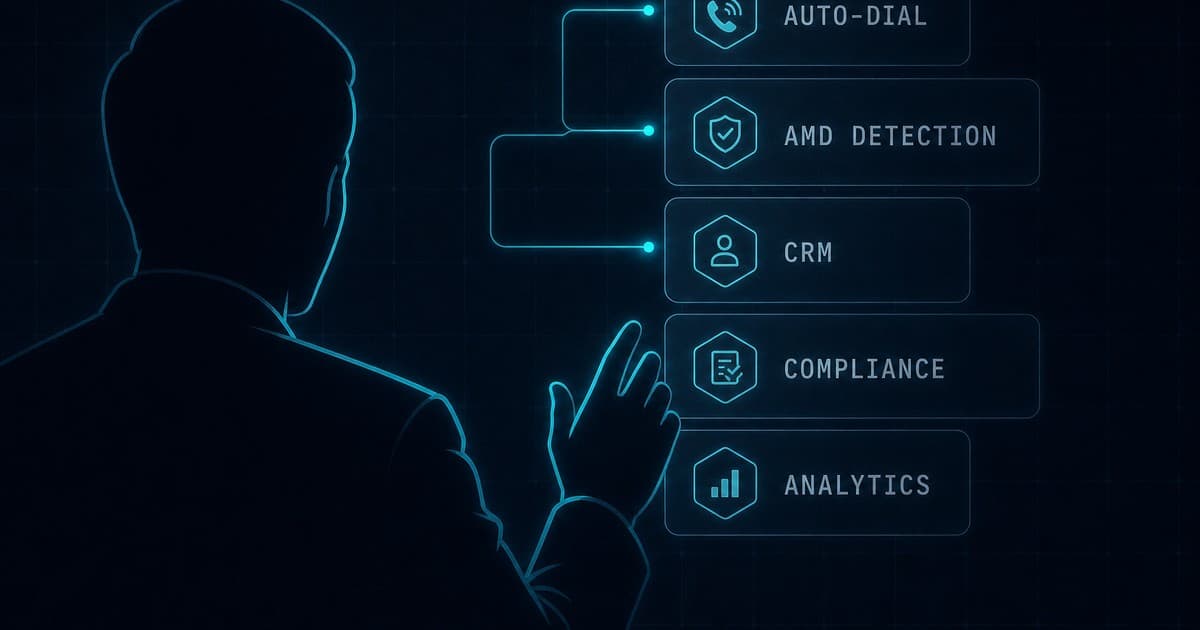
A dialer is no longer a standalone product. It is a stack. In 2026 a working outbound setup combines dialing logic, answer-machine detection, CRM synchronization, compliance scrubbing, reputation monitoring, and call analytics.
What are the six layers of the 2026 dialer stack?
| Layer | Function |
|---|---|
| 1. Dialing engine | Initiates and manages outbound calls |
| 2. Answer detection | Distinguishes live human from voicemail |
| 3. CRM integration | Surfaces prospect data, logs outcomes |
| 4. Compliance layer | DNC scrubbing, consent tracking, state rules |
| 5. Reputation monitoring | Tracks DID flag status, CNAM, attestation |
| 6. Analytics | Producer metrics, funnel diagnostics, call recording |
Missing any layer creates a specific failure mode.
Which dialing mode fits insurance outbound best?
The dialing mode is the biggest decision here. Each has a legitimate use case.
What is manual / click-to-dial good for?
The producer clicks to initiate each call. Slowest throughput, highest call quality. Best for high-value B2B or true warm-transfer environments.
When does progressive (1:1) dialing make sense?
The dialer places one call per producer, advancing only after the current call completes. Standard for most insurance outbound. Zero abandonment risk.
Is predictive (ratio) dialing worth the compliance risk?
The dialer places multiple calls per producer simultaneously, routing answers to available agents. Throughput gains are real but so are the compliance risks. See call abandonment for reputation impact, and 47 CFR § 64.1200(a)(6) for the FCC's abandonment ceiling.
Where does preview dialing fit?
The producer sees prospect info for a brief window before the dial fires. Useful for complex verticals requiring context before speaking.
How is power dialing different from progressive or predictive?
Similar to progressive but with a configurable pacing ratio. Shares some of predictive's efficiency without equivalent abandonment exposure if tuned conservatively.
| Mode | Throughput | Compliance Risk | Insurance Fit |
|---|---|---|---|
| Manual | Low | Minimal | High-touch, B2B |
| Progressive | Medium | Low | P&C, FE, most use cases |
| Predictive | High | Moderate-High | Large call centers only |
| Preview | Low-Medium | Minimal | Complex product sales |
| Power | Medium-High | Low-Moderate | Hybrid operations |
"Progressive and predictive are not the same tool. Below about 20 concurrent reps, predictive just burns numbers without adding meaningful throughput." (Reflected repeatedly across r/sales and r/telemarketing discussions on dialer pacing, and consistent with CallHub's power-vs-predictive comparison.)
How should answer machine detection be configured?
AMD decides whether a call connected to a live human or a voicemail greeting. Getting it wrong either way is expensive.
False positives (live human detected as voicemail): the call disconnects or drops to a voicemail message while a real prospect is saying hello. Lost opportunity, and under most interpretations of 47 CFR § 64.1200(a)(6) a technical abandonment.
False negatives (voicemail detected as human): producer connects to a recording, wastes 5-15 seconds. Lost productivity.
Healthy AMD configuration in 2026:
| Metric | Target |
|---|---|
| Overall AMD accuracy | >92% |
| False positive rate (live flagged as VM) | <5% |
| False negative rate (VM flagged as live) | <7% |
| Time to classification | <1.5 seconds |
| Configurable sensitivity per campaign | Yes |
Most off-the-shelf AMD defaults (including Twilio's baseline AMD) are tuned on the aggressive side. Producers should be able to adjust the greeting threshold, maximum analysis window, and beep-detection logic per campaign.
What does table-stakes CRM integration look like in 2026?
The dialer has to talk to whatever system of record holds prospect data. In 2026 the table stakes are:
- Bidirectional sync (dial outcomes flow back to the CRM in real time)
- Click-to-dial from the CRM record screen
- Screen-pop with prospect context on inbound
- Call recording storage linked to the CRM activity
- Disposition codes that map cleanly between systems
Integrations that only support CSV import/export typically burn meaningful producer time on manual data shuttling, which is unacceptable at 2026 labor rates.
Common CRM targets in insurance: AMS360, EZLynx, HawkSoft, Applied Epic, Salesforce Financial Services Cloud, HubSpot, and a long tail of agency-built tools. Any modern dialer should have native connectors or a documented API that can be wired to any of these in under a day of integration work.
What does layer 4 compliance actually need to cover?
This is where agencies most often under-invest until an enforcement action makes it expensive.
What does proper DNC scrubbing include?
Real-time check against the federal Do-Not-Call registry, state-level DNC lists (most states publish separately), and the agency's internal DNC list. Internal DNC is the one most often neglected. A prospect who asks to be removed should be blocked across every DID the agency owns, not just the one that dialed them. The FTC Telemarketing Sales Rule codifies these obligations at 16 CFR Part 310.
How should TCPA consent tracking work in the dialer?
Every prospect record should carry a consent status (express written consent, inquiry-based exemption, or none) with an audit-trail timestamp. The FCC 24-24 consent revocation rules (CG Docket 02-278) make this mandatory in practice. Portions of the global-revocation provisions were delayed by limited waiver but the core requirements are in force.
How does the dialer enforce state-specific rules?
Several states have stricter rules than federal TCPA. Florida's Telephone Solicitation Act (F.S. 501.059) and similar statutes in Oklahoma, Washington, and Maryland impose additional consent and calling-hour requirements. The compliance layer should enforce these automatically based on the prospect's state.
When should the dialer query the Reassigned Numbers Database?
The FCC operates the Reassigned Numbers Database (RND). Callers who check the RND receive safe-harbor protection under 47 CFR § 64.1200(m). Dialers should check RND status before dialing any number where consent was collected more than a few months ago.
| Compliance Feature | Non-negotiable in 2026? |
|---|---|
| Federal DNC scrubbing | Yes |
| State DNC scrubbing | Yes |
| Internal DNC enforcement | Yes |
| Calling hour enforcement by prospect state | Yes |
| Consent status per record | Yes |
| RND integration | Yes |
| Consent-revocation propagation | Yes |
| Automated recording disclosure (where required) | Yes |
What does reputation monitoring actually need to surface?
A producer who cannot see which of their DIDs are flagged is flying blind. The 2026 stack includes continuous reputation visibility across major US carriers.
What this layer should surface:
- Per-DID flag status across major terminating carriers (including how the call labels from Hiya, TNS, and First Orion appear)
- CNAM display accuracy (what the recipient actually sees)
- STIR/SHAKEN attestation level (A/B/C)
- Trend over time. A number going from clean to flagged in 48 hours is the early warning you need
- Branded caller ID enrollment status under the FCC's call branding framework
Many dialers include basic "is this number blocked" checks. Those are not sufficient. Cross-carrier display monitoring is a distinct function, and a dialer monitoring its own deliverability has an obvious conflict of interest.
Which analytics reports does layer 6 owe me?
The analytics layer should answer three questions:
- Per producer: how is each seller performing vs benchmark?
- Per DID: which numbers are producing and which are burning?
- Per list: which sources convert, and at what acquisition cost?
Minimum reports:
- Dials per producer per hour (live vs paused time)
- Answer rate per DID over rolling 7/30 days
- Conversation length distribution (bimodal = problem)
- Disposition breakdown per campaign
- Quote-to-bind funnel per producer
Call recording with transcription has moved from nice-to-have to standard in 2026. Recordings remain subject to state two-party-consent laws and should include appropriate disclosure.
Which integration pattern fits my agency size?
| Pattern | Description | Fit |
|---|---|---|
| All-in-one | Single vendor provides layers 1-4 and 6 | Small-to-mid agencies (<15 producers) |
| Dialer + CRM + compliance add-on | Three vendors, clean integrations | Mid-size (15-50 producers) |
| Specialist-per-layer assembly | Separate vendor per layer | Larger operations with integration engineering |
Reputation monitoring (layer 5) is almost always a separate vendor regardless of the pattern.
What buy-side evaluation steps should every agency run?
- Run a two-week pilot with real producer volume. Demos do not reveal real-world performance.
- Ask for a reference customer in the same product segment at similar scale.
- Verify actual AMD accuracy on a test list, not vendor-claimed.
- Confirm the compliance layer covers every state you dial into.
- Confirm consent-revocation propagation across DIDs.
- Check export capability. Call records, recordings, and prospect data should be exportable at any time.
- Review the SLA and the process for reporting outages.
Which dialer anti-patterns quietly destroy performance?
Configurations we see repeatedly that quietly destroy performance:
- Using predictive dialing under roughly 20 concurrent producers (abandonment rates spike below this threshold).
- Running AMD defaults without tuning.
- Skipping internal DNC enforcement. Creates compliance exposure every time a rep takes a "do not call me" request verbally.
- Relying on the dialer's built-in "is this number blocked" check as the only reputation signal.
- Pooling dozens of producers on a handful of DIDs (concentrates volume into a fingerprint that trips carrier filtering).
See related guides on outbound benchmarks and quarterly DID health.
What questions do agents ask most about the 2026 dialer stack?
Are all six layers required?
Yes, if the operation does meaningful outbound volume. Anyone doing 100 or more dials a day per producer needs all six.
Can one vendor cover all six layers?
Some claim to. In practice, reputation monitoring (layer 5) works best as an independent third party, and compliance (layer 4) often has gaps that require supplemental tools.
What is the right budget for the full stack?
For a 5-producer operation, ranges from several hundred dollars per producer per month on the low end into four figures at the high end, depending on CRM choice and feature set. Scale economics kick in above roughly 20 producers.
Is predictive dialing required?
Most insurance outbound operations do not. Predictive gains matter above roughly 25 concurrent producers. Below that, progressive hits better compliance numbers and equivalent throughput.
What about SMS or text integration?
SMS is a separate compliance track. 10DLC brand and campaign registration via The Campaign Registry. Treat SMS as a related but distinct workstream.
How often should I re-evaluate the stack?
Annually at minimum. Carrier rules, FCC rules, and vendor capabilities all move fast enough that a three-year-old stack is usually leaving performance on the table.
What is the single most common gap?
Reputation monitoring. Most agencies have every other layer in place and still cannot answer "which of our numbers are flagged right now?"
Does the FCC require STIR/SHAKEN for my dialer?
47 CFR § 64.6301 places the implementation obligation on voice service providers, not on business end-users directly. But attestation level propagates to your caller ID display and affects answer rates, so it is your problem operationally even if the obligation sits with the carrier.
Are you ready to see which of your DIDs are flagged?
LineAudit checks your first 5 DIDs free. You'll see exactly which numbers are flagged, mis-registered, or at risk in 30 seconds.
LineShield is operated by licensed P&C insurance agency owners, serving captive and independent agents across the U.S. Read more about our team.
How we review: every guide is drafted from carrier and analytics-partner documentation, then fact-checked against live dialer data, because reputation rules shift constantly. Additionally, we re-verify each guide when carrier behavior changes.
Corrections: if you spot an error, contact us at customerservice@theidudes.com and we will fix it promptly.