
CNAM Registration: The 20 Minute Fix Carriers Skip
CNAM is the caller ID name database your outbound carrier almost certainly skipped. Here is how LIDB works, why it matters, and how to fix your DIDs fast.
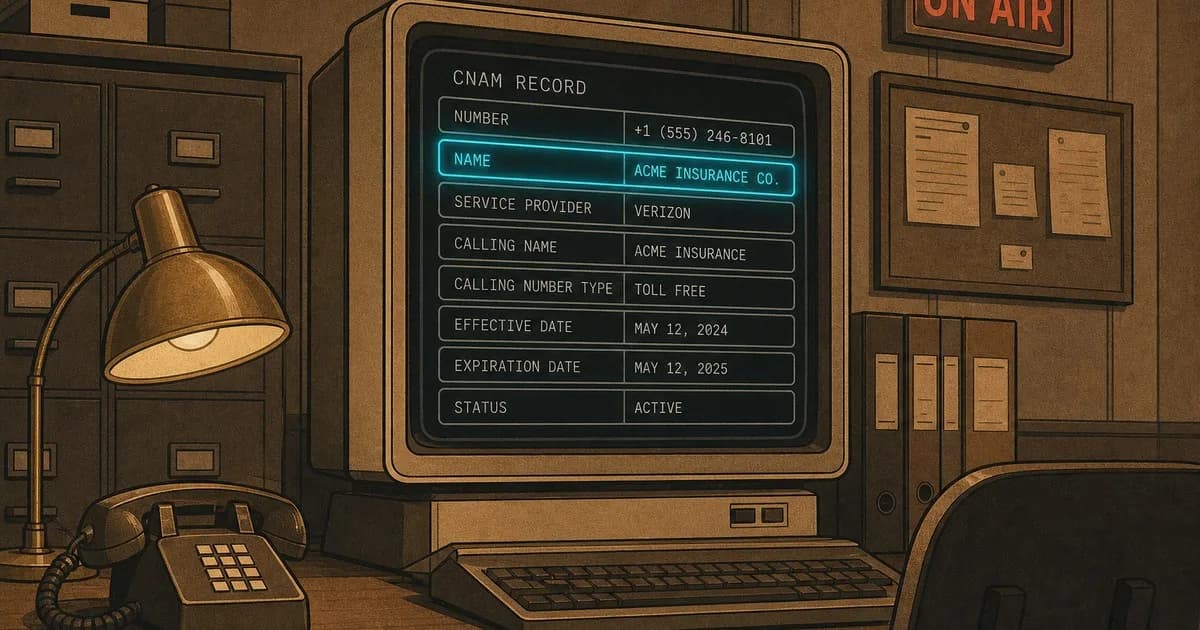
When you port a number into your dialer or buy a new DID from a VoIP provider, there is a checkbox nobody checked on your behalf, and it is the reason your outbound calls show up as "Unknown," "Wireless Caller," or blank on your prospects' phones. That checkbox is CNAM registration, and most VoIP carriers skip it by default because they are not paid to do it. This post explains what CNAM is, why LIDB sits underneath it, and what registering properly actually entails in 2026.
What is CNAM and how does it differ from the calling number itself?
CNAM stands for Caller ID Name. It is the 15-character text string that appears above the phone number when you call someone (the "John Smith" or "ALLSTATE AGCY" portion of the caller ID). Standard CNAM fields are capped at 15 alphanumeric characters with at least one non-digit character (Bandwidth CNAM overview). The number itself (ANI, or Automatic Number Identification) is transmitted with every call automatically. The name is not.
Here is the crucial detail most agents do not know: the calling carrier does not send the name. The receiving carrier looks it up.
When your call arrives at the terminating carrier's switch, the switch performs a database lookup against a system called LIDB (Line Information Database), or more specifically against the CNAM database layer that sits on top of LIDB. It finds the record associated with your 10-digit number, pulls the 15-character name, and displays it to the called party.
If there is no record, or the record is stale, or the record says "WIRELESS CALLER," that is what the recipient sees. Your business name is nowhere in the flow.
How is LIDB different from CNAM?
Agents and even some VoIP salespeople use these terms interchangeably, but they are distinct.
| System | Purpose | Who maintains it |
|---|---|---|
| LIDB | Master line-information database (billing, line class, calling card validation, CNAM pointer) | Originally the RBOCs; now aggregators such as iconectiv (formerly Neustar) and Syniverse |
| CNAM database | The actual "name string" storage, queried by terminating carriers during call setup | Multiple providers, each with their own copy |
| CNAM dip | The real-time query a terminating carrier performs | Costs the terminating carrier a per-dip fee, typically a fraction of a cent to low single-digit cents |
Because the terminating carrier pays for the dip, they want accurate records. If your number is not in the CNAM databases their network uses, you get a default label. Often "Wireless Caller" or the city/state of the NPA-NXX, which is worse than useless for an insurance agent trying to build trust.
Why does my VoIP carrier almost always skip CNAM registration?
When a VoIP provider hands you a new DID, three things usually happen automatically:
- The number is provisioned to your trunk.
- STIR/SHAKEN signing is enabled at some attestation level.
- Nothing else.
CNAM registration is usually either:
- A paid add-on ($0.50-$2.00 per number per month with some providers),
- A manual support ticket you have to open,
- Or a feature the provider simply does not offer and you have to purchase through a third party like iconectiv, Bandwidth, or a CNAM aggregator.
For a solo agent running 3 DIDs, this is annoying. For an agency running 40, 100, or 200 DIDs with no CNAM, the data indicates a significant effect on contact rate. Top-of-funnel issues compound negatively for your telefunnel downstream. Some carriers may care more about selling you more lines than protecting your reputation.
What are operators reporting about CNAM display across carriers?
The pattern shows up repeatedly on VoIP community forums and agent threads. As one operator summarized on the VoIP-info forum in a long-running "Outbound CNAM (Company) Name, how exactly?" thread, the industry-wide CNAM service is not generally used by wireless carriers, so calls to mobile devices may display nothing even with a registered name unless the recipient has the number saved as a contact (VoIP-info forum thread). Service provider documentation confirms the same thing: a number can appear correct on AT&T, outdated on Verizon, and blank on T-Mobile simply because each carrier sources CNAM from a different database on a different refresh cadence (Cloud Service Networks on why CNAM doesn't display).
What does "registered correctly" mean for CNAM in 2026?
It used to be enough to just get your business name into one CNAM database. Not anymore. In 2026, "CNAM registered" means all of the following:
- Your DID appears in the primary CNAM database (typically iconectiv LIDB).
- The 15-character name field reflects your actual business name (not "J SMITH INS" when your LLC is "Smith Insurance Group LLC"), because analytics engines cross-reference this against your registered entity name.
- The record propagates to downstream CNAM databases (each carrier may use a different one, and propagation can take 24-72 hours).
- The CNAM record matches your STIR/SHAKEN signing identity. Mismatches here trigger reputation penalties from Hiya Inc., TNS, and First Orion. See Hiya, TNS, and First Orion: The Three Labeling Algorithms Killing Your Pipeline.
- The record stays current. CNAM records do not expire exactly, but they can be overwritten, and the databases get out of sync. Re-verification quarterly is a reasonable baseline.
Why is CNAM registration necessary but not sufficient?
Here is the honest truth that some CNAM vendors will not tell you. On most modern wireless handsets (iPhones on iOS 15+, most Android devices) the analytics vendor display layer (Hiya, TNS, First Orion) sits above the CNAM layer. That means even a perfectly registered CNAM name can be overridden by a spam label if your reputation score is bad.
CNAM still matters because:
- It is one of the signals analytics engines use to decide if you look legitimate.
- On wireline phones, VoIP softphones, and older devices, CNAM is still the only display name source.
- Inside corporate PBX environments (where many of your B2B prospects sit), CNAM is often still primary.
But CNAM is necessary, not sufficient. You also need to clean up your reputation footprint.
How do I actually register CNAM correctly?
Four paths, in order of control:
- Direct with iconectiv (formerly Neustar). Most control, highest setup friction. Good for agencies with 20+ DIDs.
- Through your VoIP provider's CNAM add-on. Easiest, but you are trusting them to do it right. Verify with a test dip after activation.
- Through a CNAM aggregator (Bandwidth, Inteliquent, TransNexus, etc.). Middle ground.
- Through a branded-calling provider (Hiya Connect, First Orion INFORM, TNS Enterprise Branded Calling). This is separate from traditional CNAM but addresses the display problem on modern handsets (First Orion INFORM).
Pick the path, but actually verify the result with a cross-carrier dip test.
What are the most common CNAM mistakes that hurt agents?
Using a DBA instead of your legal entity name. If the CNAM says "AGENT JOHN" and your business is legally "Smithfield Insurance Agency, Inc.," analytics engines flag the mismatch.
15-character overflow that creates nonsense. "JOHNSON FAMILY INSUR" reads fine. "JOHNSONFAMILYIN" does not. Craft the 15 characters as a human would read them.
Registering once and forgetting. Databases drift. An annual review catches 80% of silent failures.
Assuming mobile handsets will display it. They increasingly do not. Pair CNAM with branded-calling enrollment for full coverage.
What questions do agents ask most about CNAM registration?
How long does CNAM registration take to propagate?
Typically 24 to 72 hours across the major CNAM databases. Some downstream caches persist longer.
Does CNAM work on iPhones?
Sometimes. On iOS, CNAM is displayed if the number is not matched against a contact and no analytics override fires. In practice, many agents find iOS displays their number alone because the analytics layer intervenes.
Can I have a different CNAM for each of my DIDs?
Yes. Each DID is an independent record. You can set per-line names if you want producer-specific branding.
Should I register CNAM if I have STIR/SHAKEN Level A?
Yes. They solve different problems. STIR/SHAKEN authenticates that you are who you claim to be. CNAM controls what name displays. Both matter.
Why does my number still show "Wireless Caller" after I registered?
Usually one of three causes: the registration only hit one database (not all of them), the terminating carrier is bypassing CNAM in favor of analytics, or propagation has not completed. Cross-carrier dip tests tell you which.
Is CNAM free?
Registration typically carries a small monthly fee per DID ($0.50 to $2 per month). The dip itself is paid by the terminating carrier, not you.
Does CNAM help my spam reputation?
It is one signal among many. Having a consistent, accurate CNAM that matches your legal entity and STIR/SHAKEN identity helps reputation scoring. It does not override bad behavioral patterns. See What a "Clean" DID Actually Looks Like in 2026.
What is the difference between LIDB and CNAM?
LIDB is the master line-information database. It stores billing, line class, and pointers. CNAM is the specific caller-name lookup service that sits on top of LIDB. The terminating carrier queries CNAM (which may hit LIDB under the hood) to fetch the 15-character name displayed on the recipient's phone. For a deeper map of the terminology, see LIDB, CNAM, and the alphabet soup of caller ID.
Can I register CNAM for a VoIP number the same way as a landline?
Functionally yes, but the path differs. Landline CNAM records are typically written by the originating carrier as part of LIDB. For VoIP DIDs, you or your provider have to explicitly submit records to iconectiv or an aggregator. It is not automatic.
Are you ready to see which of your DIDs are flagged?
LineAudit checks your first 5 DIDs free. You'll see exactly which numbers are flagged, mis-registered, or at risk in 30 seconds.
LineShield is operated by licensed P&C insurance agency owners, serving captive and independent agents across the U.S. Read more about our team.
How we review: every guide is drafted from carrier and analytics-partner documentation, then fact-checked against live dialer data, because reputation rules shift constantly. Additionally, we re-verify each guide when carrier behavior changes.
Corrections: if you spot an error, contact us at customerservice@theidudes.com and we will fix it promptly.