
Carrier Business Classification: Why Yours Kills Answers
Carrier classification via LERG, CNAM, and analytics engines decides whether your outbound calls connect. Here's how the system misreads insurance agents.
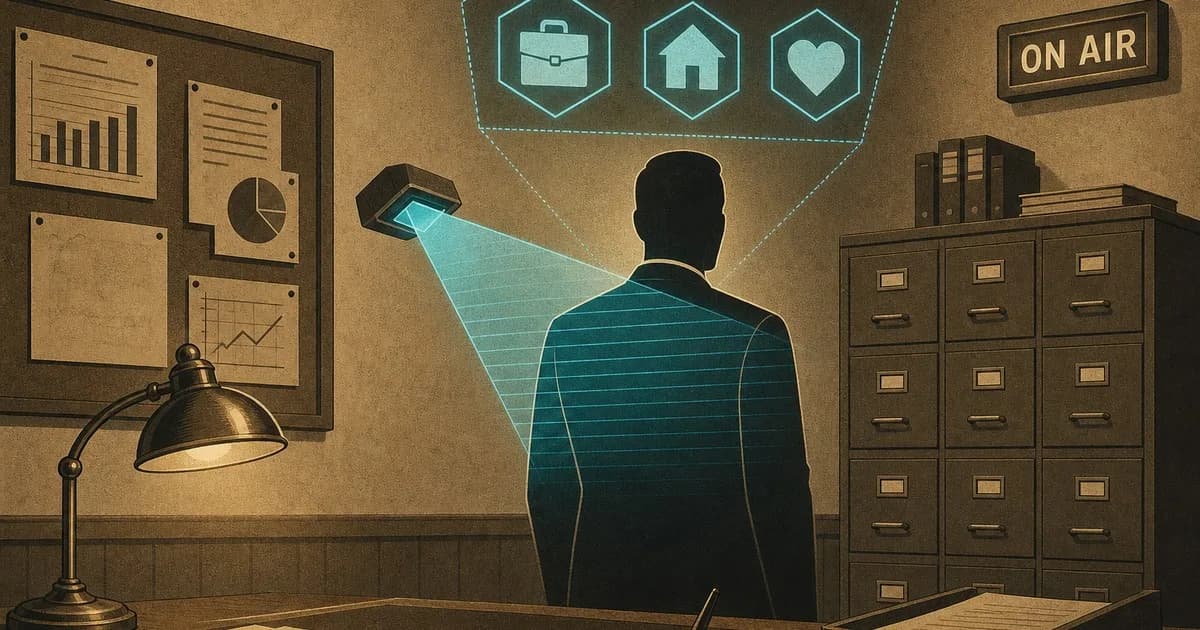
Carriers classify your business through a three-layer stack: the Local Exchange Routing Guide (LERG) maintained by iconectiv, your Caller Name (CNAM) record, and analytics engines run by Hiya Inc., TNS, and First Orion. Insurance agents routinely get labeled telemarketer, debt collector, or "Spam Likely" because their behavioral pattern overlaps with what the models were trained to catch. This post breaks down the stack, the specific failure modes that hit agent dialers, and the remediation channels that actually work.
Before a prospect ever sees your caller ID, three systems have decided what kind of business you are.
What are the three layers of carrier classification?
What does the LERG record about my numbers?
The Local Exchange Routing Guide, maintained by iconectiv, is the authoritative record of which carrier owns which number block and which rate center it belongs to. Every carrier queries it to route a call. LERG does not classify business types, but it does classify numbers as wireline, wireless, VoIP, or toll-free, and that classification changes how downstream systems treat your traffic.
What does the CNAM layer actually display?
Caller Name (CNAM) is the display string shown on the called party's device. The originating carrier stores the CNAM record; terminating carriers do a CNAM dip to retrieve it. The CNAM ecosystem is fragmented. Dozens of providers maintain records and they do not always agree. You can have a correct CNAM on Neustar and a stale or wrong one on TNS, and the prospect sees whichever record their carrier queries.
Which analytics engines apply the "Spam Likely" labels?
This is where most misclassification damage happens. Hiya (AT&T + Samsung devices), TNS Call Guardian (T-Mobile, US Cellular, Verizon feeds), First Orion (legacy Sprint/T-Mobile + Virgin), RoboKiller, and Truecaller each run their own scoring models. They ingest call patterns, consumer complaints, honeypot hits, and third-party data. Their output is the "Spam Likely," "Scam Risk," "Telemarketer," or "Fraud" label on the handset.
No single engine is authoritative, and they use different taxonomies.
Why do insurance agents get misclassified so consistently?
Agent dialers have a behavioral signature classification models struggle with:
- High daily dial volume from a small DID pool. Looks like a telemarketer.
- Short average call duration. Looks like a robocaller.
- Structurally low answer rate. Per the Hiya 2024 State of the Call report, 46% of unidentified calls go unanswered. That low base rate feeds the "unwanted" signal.
- Geographic dial spread mismatched with DID rate center. Looks like local-presence spoofing.
- Traffic spikes after list drops. Looks like a burst campaign.
Analytics models were trained on traffic dominated by actual scam operations. Legitimate insurance outbound happens to share four or five surface features with the behavior the models were built to catch.
Agent-community discussion on Insurance Forums captures the lived reality: numbers that perform clean for weeks can be flagged by a single complaint cascade, and the complaint rate on insurance outbound is structurally higher than on most verticals. The Hiya scam-of-the-month report on insurance makes the regulatory classifier's job harder; consumer-reported scams actively poison the category.
How does the classification taxonomy differ across engines?
| Engine | Typical Labels on Insurance Outbound | Primary Carrier / Device Coverage | Remediation Channel |
|---|---|---|---|
| Hiya | "Spam Risk," "Telemarketer," "Insurance" | AT&T, Samsung devices | Hiya Connect |
| TNS Call Guardian | "Nuisance," "High Risk," "Telemarketer" | T-Mobile, US Cellular, Verizon feeds | TNS Enterprise |
| First Orion | "Spam Likely," "Scam Likely" | Sprint/T-Mobile legacy, Virgin | First Orion Branded Communication |
| RoboKiller | "Robocaller," "Spam" | Consumer app, post-pickup blocking | RoboKiller dispute |
| Truecaller | "Spam," "Telemarketer" | Consumer app, Android-dominant globally | Truecaller business |
The same DID can be labeled "Spam Likely" on First Orion, "Insurance" on Hiya, and clean on TNS, all at the same moment. What the consumer sees depends on their carrier, device, and installed apps.
Which registration channels close the classification gap?
Remediation channels exist for each engine. Most agencies don't use them because they don't know they exist.
- Free Caller Registry: single form that feeds Hiya, TNS, and First Orion simultaneously.
- Hiya Connect / Hiya Business: registration plus branded calling.
- TNS Enterprise: call authentication and reputation management.
- First Orion Branded Communication: similar model.
- FCC consumer complaint scrubbing via the FCC Consumer Complaint Center: limited, but worth filing for wrongful labels.
Registering with each engine does not guarantee a clean label. It gives the engine a verified record to weight against behavioral signals. An insurance agent that registers, keeps CNAM current, and holds volume under aggressive thresholds sees dramatically fewer misclassifications than one relying on the carrier to "handle it."
What does a correct CNAM record look like for an agency?
A correctly registered CNAM has three properties:
- Matches the brand the prospect recognizes. "Insurance Dudes" beats "IDUDES LLC" which beats "VOIP INC."
- Consistent across the pool. If ten DIDs show ten different CNAMs, analytics engines treat the pool as suspicious.
- Registered at the right layer. CNAM set only at the dialer does not survive carrier dips. It must be registered with the underlying carrier and propagated to major CNAM providers. Numeracle's breakdown walks through the specific propagation steps.
For fixing CNAM at the source, see CNAM Registration Explained and What a Clean DID Looks Like in 2026. The misread usually traces back to how carrier reputation scoring works.
What is the LERG-propagation misclassification trap?
A subtle failure mode: when a number block changes hands between carriers, the LERG entry updates but downstream analytics caches can lag weeks. During the lag, your DID can be treated as belonging to a carrier with a worse reputation in the analytics models. This is why some agencies see a flag wave after switching origination providers, even when nothing about dialing behavior changed.
The fix is not fast. Give the LERG 7-14 days to propagate, keep dial volume low during the window, and re-audit analytics labels weekly until they stabilize.
Does STIR/SHAKEN attestation override classification labels?
The FCC's STIR/SHAKEN framework mandates that originating carriers attest to caller identity. Full (A) attestation means the carrier authenticated the caller and verified their number rights; B and C attestation mean less. Full attestation is a routing prerequisite, not a classification cleaner. A fully-attested call can still be labeled "Spam Likely" if behavior triggers an analytics engine. Kixie's analysis of Salesforce outbound shows this pattern repeatedly.
What classification cleanups can I run this week?
If you do nothing else:
- Pull current CNAM across at least three providers and flag mismatches.
- Register the business pool on the Free Caller Registry.
- Register directly with Hiya, TNS, and First Orion.
- Check the LERG entry for every DID against what your carrier claims.
- Audit all active DIDs for analytics labels and pull dirty ones out of rotation.
- Standardize CNAM across the entire pool.
What questions do agents ask most about carrier classification?
What is the difference between CNAM and call analytics labeling?
CNAM is the name displayed as caller ID. Analytics labeling ("Spam Likely," etc.) is a separate overlay applied by the terminating carrier or handset app. A clean CNAM does not protect you from a bad analytics score, and vice versa.
Is there a single authoritative database I can check for business classification?
No. Classification is distributed across the LERG, multiple CNAM providers, and at least five major analytics engines. A full audit queries each layer separately.
Why do different people see different caller ID names for the same DID?
Their carriers query different CNAM providers, and those providers hold different records for the same number. Keeping CNAM consistent across the major providers minimizes drift.
Can I appeal a "Spam Likely" label on my business number?
Yes, through each engine's registration portal. Hiya, TNS, and First Orion all accept business appeals. Success varies. A clear, registered identity helps. A dial pattern that still triggers the model will re-flag within days.
Does STIR/SHAKEN attestation fix misclassification?
No. STIR/SHAKEN verifies that the originating carrier vouches for the caller ID. It is a prerequisite for being trusted, not a classification cleaner. A fully attested call can still get labeled "Spam Likely."
How fast do analytics engines respond to behavior changes?
Flag-on is fast. A spike in complaints or honeypot hits can flag a DID within hours. Flag-off is slow. Rehabilitation typically takes 30 to 60 days of clean behavior, if the flag is reversible at all. Per SaleSHive and Kixie, the asymmetry is a central reason agencies over-rotate DIDs.
Should my CNAM include "Insurance" in the name?
It depends on the market. "Insurance" in CNAM is honest and builds trust with expecting prospects, but can trigger handset-level filters where consumers have set category blocks. Test both framings against answer rate.
What is the Free Caller Registry and does it cost money?
The Free Caller Registry is a single registration form that feeds Hiya, TNS, and First Orion. It is free for legitimate businesses. Registration takes three to seven business days to propagate and does not guarantee a clean label. It establishes a verified record.
Are you ready to see which of your DIDs are flagged?
LineAudit checks your first 5 DIDs free. You'll see exactly which numbers are flagged, mis-registered, or at risk in 30 seconds.
LineShield is operated by licensed P&C insurance agency owners, serving captive and independent agents across the U.S. Read more about our team.
How we review: every guide is drafted from carrier and analytics-partner documentation, then fact-checked against live dialer data, because reputation rules shift constantly. Additionally, we re-verify each guide when carrier behavior changes.
Corrections: if you spot an error, contact us at customerservice@theidudes.com and we will fix it promptly.