
The Economics of Buying vs. Porting Phone Numbers in 2026
Buy new DIDs or port existing ones? Real cost breakdowns, timeline differences, and reputation tradeoffs for insurance agents shopping numbers in 2026.
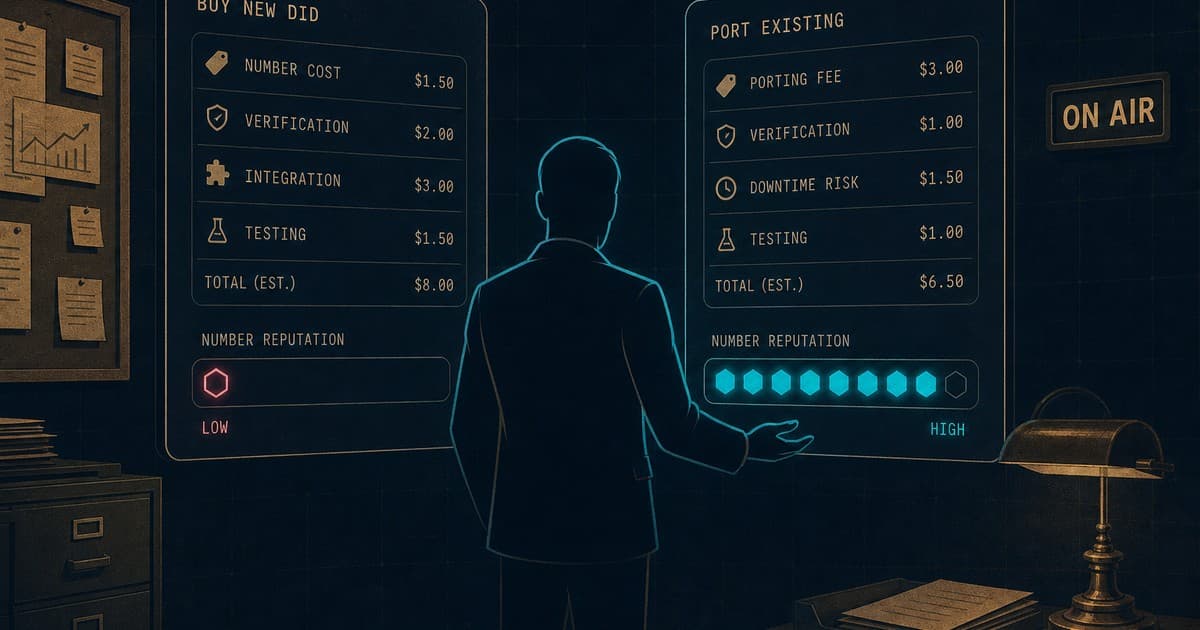
For an agent refreshing a DID (Direct Inward Dial) pool in 2026, the decision comes down to one question: acquire new numbers directly from a carrier, or port existing numbers in from another provider. The answer depends on reputation history, timeline pressure, and how much operational friction the agency can absorb. Below is the actual cost and timeline comparison, with the failure modes each path exposes.
Why does the buy-vs-port decision matter more than it used to?
Five years ago, a DID was a commodity. Any ten-digit number worked as well as any other. That is no longer true. Every number in the North American Numbering Plan now carries a reputation score, an attestation history under the STIR/SHAKEN framework codified at 47 CFR § 64.6301, a CNAM (Caller ID Name) record, and increasingly a branded caller ID registration status. Acquiring a new DID means starting that history from zero. Porting a DID means inheriting whatever history it already has.
That inheritance can be good or catastrophic.
What does buying new DIDs from a carrier actually cost?
New DID acquisition means requesting a number from a carrier's available inventory. The number may be genuinely fresh (never previously assigned) or recycled (returned from a prior customer after an aging period governed by 47 CFR § 52.15).
What is the cost structure for buying new DIDs?
| Line Item | Typical 2026 Range |
|---|---|
| Per-DID activation fee | $0.50 - $2.00 |
| Monthly DID rental | $0.50 - $1.50 |
| CNAM registration (one-time) | $5 - $15 |
| CNAM dip (per inbound query) | $0.003 - $0.008 |
| Branded caller ID enrollment (annual, per brand) | $300 - $1,200 |
| Per-minute outbound (domestic) | $0.004 - $0.009 |
Ranges reflect list pricing from major wholesale providers such as Twilio and Bandwidth. For a 10-DID outbound pool running 300 minutes per DID per day, annualized cost typically lands in the low four figures depending on carrier, feature set, and branded caller ID participation.
How fast can I get a new DID into rotation?
New DID provisioning is fast. From order to dialing: typically same-day to 48 hours for standard DIDs, up to 5 business days for toll-free or specific NPA-NXX requests. CNAM propagation adds another 24 to 72 hours.
What failure modes hit fresh DIDs out of the gate?
Recycled numbers with inherited flags. Aging periods for returned numbers under 47 CFR § 52.15(f) range from 45 days (residential minimum) to 365 days (business maximum). That window is often insufficient to clear spam flags. If the prior tenant burned the number with a rented local-presence operation, the flag may persist much longer.
Unknown history. A newly issued DID that has technically never been used can still be flagged if its NPA-NXX block has a poor aggregate reputation. Some analytics vendors score at the block level, not just the individual number. Quo documents this inherited-reputation pattern across recycled VoIP numbers.
Warming required. Every new DID needs 2 to 3 weeks of graduated volume before it hits stable answer rates. See our DID warming playbook.
What does porting an existing DID involve?
Porting (Local Number Portability, or LNP) moves a number from one carrier to another while preserving the number itself. Under 47 CFR § 52.36, simple wireline-to-wireline and wireless ports must be completed within one business day; business ports involving Customer Service Record (CSR) validation, letters of authorization, and multi-number bundles routinely take longer.
What does porting cost per number?
| Line Item | Typical 2026 Range |
|---|---|
| Port-in fee (per number) | $0 - $25 |
| Losing carrier port-out fee | $0 - $50 |
| Port coordination/expediting | $0 - $150 |
| Post-port CNAM re-registration | $5 - $15 |
| Branded caller ID re-enrollment | Varies |
How long does a port actually take?
| Port Type | Typical Duration |
|---|---|
| Simple wireless port (1-5 numbers) | 1-3 business days |
| Business wireline port (single DID) | 3-7 business days |
| Bulk business port (10+ numbers) | 7-21 business days |
| Complex port (E911, RCF, PRI) | 14-45 business days |
Agents consistently underestimate port timelines. Wholesale porting guidance from Bandwidth and Twilio both document that business ports commonly run two to four weeks, and that complex circuits can stretch substantially longer.
"Moving a VoIP or landline number (even to another VoIP provider) is considered a wireline port, which typically takes longer and requires more backend coordination." (Operational guidance from Quo / OpenPhone's porting FAQ, echoed across VoIP.ms community porting threads and r/VOIP.)
What does the port preserve and what does it lose?
Porting preserves:
- The number itself
- Historical reputation (good or bad)
- Existing CNAM record (often needs refresh)
- Call history patterns visible to analytics vendors
Porting does NOT preserve:
- Carrier-specific routing or call treatment rules
- The prior carrier's STIR/SHAKEN attestation history (the new carrier re-attests going forward)
- Any 10DLC SMS brand/campaign registrations (must re-register with The Campaign Registry)
- E911 address records (must re-file)
What failure modes hit a port mid-flight?
Port rejection. A mismatched CSR (Customer Service Record), wrong billing name, wrong service address, wrong billing telephone number, gets the port rejected. NoJitter's 10-reasons analysis catalogs the common causes. Rejection restarts the timeline.
Mid-port service interruption. Rare for modern ports, but still possible on complex wireline moves. Most business interruptions happen because the gaining carrier ports the DID but has not configured inbound routing on their end.
Lost reputation from misconfiguration. Porting a well-regarded number to a new carrier, then failing to immediately register CNAM and branded caller ID on the new platform, can surface the number as "UNKNOWN" for days or weeks. Reputation erodes during that window.
Which scenarios call for buying vs porting?
| Scenario | Recommendation |
|---|---|
| Adding outbound capacity for a new producer | Buy new |
| Relocating a published main office number | Port |
| Agent DID printed on business cards / website | Port |
| Replacing burned rented local-presence pool | Buy new (owned) |
| Moving established CNAM-registered DIDs to a new dialing platform | Port |
| Acquiring a vanity or memorable number from the open market | Buy (often via broker) |
| Emergency replacement of a flagged DID | Buy new, warm, deploy |
Should I buy "clean" aged DIDs from a number broker?
A small but growing market exists for "clean" aged DIDs: numbers held without use long enough to shed prior reputation. Brokers list these in the $50 to $500 range depending on NPA-NXX desirability.
Use caution. Verification that the number is actually clean requires running it through a multi-carrier reputation check before purchase. A broker's claim that a number is "aged and clean" is not sufficient. The analytics vendors (Hiya, TNS, First Orion) do not consult brokers. If the broker will not agree to a pre-purchase audit, walk away.
What is the 24-month total cost of ownership across acquisition strategies?
For a 10-DID outbound pool, modeled across three strategies using the wholesale pricing ranges above:
| Strategy | Year 1 Cost | Year 2 Cost | 24-Month Total |
|---|---|---|---|
| Buy new, own, warm | ~$2,400 | ~$1,800 | ~$4,200 |
| Port from legacy provider | ~$1,800 | ~$1,800 | ~$3,600 |
| Rent rotating pool of 500 | $9,000+ | $9,000+ | $18,000+ |
| Broker-acquired aged DIDs | ~$3,500 | ~$1,800 | ~$5,300 |
Rotating rented pools look cheaper per-number but deliver the worst deliverability and require continuous replacement as numbers burn.
What 2026 compliance shifts affect number acquisition?
Two regulatory shifts are worth tracking for anyone acquiring numbers this year.
FCC consent revocation rule. Under FCC 24-24 / CG Docket 02-278, consent to be contacted travels with the consumer, not the number. Core revocation requirements took effect April 11, 2025, with portions delayed by limited waiver through 2026-2027. Porting numbers does not give you any more right to dial a prospect who previously revoked consent.
10DLC brand re-verification. SMS brand registrations tied to ported numbers must be re-filed with the new carrier and The Campaign Registry. Failing to re-register within the grace window results in SMS traffic being blocked at mobile carrier gateways.
What is the simple buy-vs-port rule?
If the number is part of your brand (on signage, printed, with years of inbound relationship with customers), port it and plan the port carefully. If the number is pure outbound capacity for a new seat, buy new, warm it properly, and skip the port complexity. Mixing the two categories is where most operations lose reputation.
For ongoing maintenance of either type, see quarterly DID health and dialer stack fundamentals.
What questions do agents ask most about buying and porting DIDs?
Can I port a number I do not currently own?
No. Porting requires a letter of authorization signed by the current billing responsible party. Attempting to port a number you are not authorized to port is a slamming violation under 47 CFR § 64.1100-64.1190.
How long does a port take in 2026?
Simple ports are same-day to 3 days under the FCC's one-business-day rule. Business ports run 1 to 4 weeks depending on complexity. Plan for the upper end.
What is a CSR and why does it matter?
A Customer Service Record is the authoritative document from your current carrier showing account name, service address, and numbers on the account. The gaining carrier uses the CSR to validate the port request. Bandwidth's port-rejection data lists CSR mismatches as the leading cause of rejections.
Will I lose my voicemail when I port?
Voicemail is carrier-specific. It does not port. Export any stored voicemails before the port date.
Can I port a toll-free number?
Yes. Toll-free ports (RespOrg changes) follow a separate process managed through Somos and the SMS/800 database. Timeline is typically 7 to 14 days.
What happens to my number's reputation during a port?
Reputation scores persist at the number level and travel with the port. A well-regarded number stays well-regarded after porting, provided CNAM and attestation are configured promptly on the new carrier.
Is it worth porting just to consolidate bills?
Usually no. Consolidation savings rarely justify port risk. Port when there is a functional reason: better features, better analytics, better routing. Not billing simplification.
Are porting fees regulated?
The FCC prohibits carriers from imposing non-cost-based fees that obstruct porting under 47 CFR § 52.33, but reasonable administrative fees are permitted and vary widely by carrier.
Are you ready to see which of your DIDs are flagged?
LineAudit checks your first 5 DIDs free. You'll see exactly which numbers are flagged, mis-registered, or at risk in 30 seconds.
LineShield is operated by licensed P&C insurance agency owners, serving captive and independent agents across the U.S. Read more about our team.
How we review: every guide is drafted from carrier and analytics-partner documentation, then fact-checked against live dialer data, because reputation rules shift constantly. Additionally, we re-verify each guide when carrier behavior changes.
Corrections: if you spot an error, contact us at customerservice@theidudes.com and we will fix it promptly.