
Scam Likely on Your Calls? Why It Happens, How to Fix It
Why your outbound calls display as SCAM LIKELY or Spam Risk, what carriers and analytics vendors actually look at, and how agents can reclaim their caller ID.
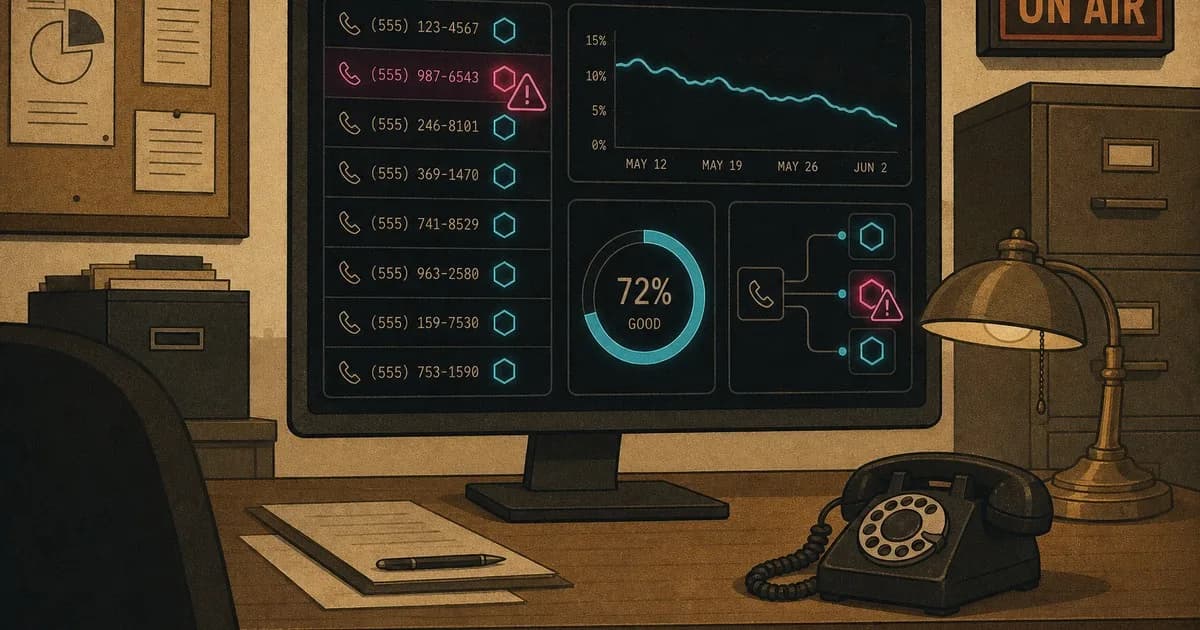
If your connect rate fell off a cliff this year and you have no idea why, there is a very good chance your outbound numbers are being displayed as "Scam Likely," "Spam Risk," or "Potential Fraud" on the other end. You cannot see it from your dialer. Your prospect sees it instantly. According to Hiya's 2024 State of the Call, 46% of unidentified calls go unanswered, and once a number carries a spam label, answer rates can drop by as much as 90% (Hiya 2024 State of the Call). This post explains, in plain English, why carriers flag numbers, what signals trigger the label, and what an insurance agent can actually do about it.
What does "Scam Likely" actually mean on a phone display?
"Scam Likely," "Spam Risk," and "Potential Spam" are not official regulatory designations. The Federal Communications Commission (FCC) requires carriers to authenticate calls via STIR/SHAKEN but does not assign these labels (FCC Combating Spoofed Robocalls). The labels are applied by the terminating carrier (the carrier on the receiving end of the call) based on reputation data supplied by one of three analytics vendors: Hiya Inc., Transaction Network Services (TNS), or First Orion. Each major US carrier partners with one of them:
- T-Mobile / Metro uses First Orion; "Scam Likely" is a First Orion product (First Orion INFORM).
- AT&T / Cricket uses Hiya.
- Verizon uses TNS Call Guardian.
When your call hits the tower, the carrier queries its analytics partner in real time. If that partner has decided your number looks like a spammer, the carrier overwrites your caller ID with a warning label before the phone ever rings.
The label is applied per carrier, per analytics vendor, which means the same number can ring cleanly on Verizon and get torched on T-Mobile in the same hour. Most agents never realize this because they test on their own phone and assume everything is fine.
Which behavioral signals actually trigger a spam flag?
Analytics engines are not reading your script. They are looking at behavioral patterns across billions of calls per quarter. Hiya alone flagged 13.7 billion suspected spam calls in Q2 2025 (Hiya Global Call Threat Report). The biggest drivers:
How does call volume vs answer rate trip the flag?
A number that makes 300 calls a day and gets answered on 8% of them looks exactly like a telemarketer. A number that makes 30 calls and gets answered on 40% looks like a human. The ratio matters more than the absolute number. Industry guidance suggests that dialing above roughly 100-150 calls per day from a single DID with short durations materially increases flagging risk (Caller ID Reputation on dialing practices).
Why does short call duration accelerate flagging?
If most of your calls last under 6 seconds (because people are hanging up on you) the carrier sees that pattern and raises your risk score. Ironically, being flagged causes more hangups, which increases the flag. This is the spam death spiral.
How much weight do consumer complaint reports carry?
Every time a consumer hits "Report Spam" in their native dialer, or in the Hiya, Robokiller, or TrueCaller app, that feedback loops directly back to the analytics engine tied to their carrier. According to TNS survey data, 43% of US respondents filed a robocall complaint with a state Attorney General, the Federal Trade Commission (FTC), or the Do Not Call Registry in the prior year. Consumers are actively reporting (TNS 2026 Robocall Report). It only takes a handful of reports on a low-volume number to tip it over.
Does the number's reuse history bleed into my reputation?
DIDs get recycled. The 10-digit number you just got from your VoIP provider may have been a debt collector's workhorse six months ago. You inherited its reputation.
How do mismatched or missing CNAM registrations trip the algorithm?
If the CNAM (Caller ID Name) on your number is blank, set to "Wireless Caller," or does not match the business you claim to represent, you look like you are hiding. Analytics engines treat that as a high-risk signal. See our breakdown in CNAM Explained: The Registration Step Your Carrier Probably Skipped.
What does low or missing STIR/SHAKEN attestation cost me?
If your carrier is signing your calls at attestation level B or C (or not at all), downstream carriers treat you as unverified. The TNS 2026 Robocall Investigation Report flagged that up to 13% of signed traffic on invalid numbers still received Level A attestation in 2025, which has made terminating carriers more aggressive about scrutinizing the full reputation picture even on signed calls (TNS 2026 Robocall Report). Full treatment in STIR/SHAKEN for Insurance Agents: A Plain-English Guide.
Why do insurance agents get hit harder than other verticals?
Insurance is one of the most penalized verticals in the labeling algorithms. It is not personal; it is pattern. Insurance outbound has four properties that perfectly match the algorithmic definition of "spam":
| Pattern | Insurance reality | How algorithm reads it |
|---|---|---|
| High daily dial count | Agents dial 100-300+ per day | Looks like telemarketing |
| Low answer rate | Cold lead lists answer at 2-6% | Looks like spam |
| Short average duration | Most unanswered calls = 0 sec | Looks like abandonment |
| Frequent new DIDs | Agencies cycle numbers monthly | Looks like number burning |
The algorithms were built to catch exactly this kind of pattern. Agents (even fully licensed, fully compliant ones) trip every wire. Industry surveys back this up: an ACA International member survey cited across carrier-vendor blogs reported 78% of respondents experienced call blocking and 74% reported mislabeling on legitimate business numbers (Hiya blog on business mislabeling).
What are agents reporting in the forums about this?
Agent-community forums are full of the same pattern. On the Insurance Forums community, one licensed agent opened a thread titled "Need help: Number getting flagged as spam," describing watching their own business number go from clean to "Spam Risk" in a matter of weeks despite running the same cadence for years (Insurance Forums thread). On BiggerPockets, real estate operators running similar outbound motions have documented the same collapse and the confusion when carriers offer no remediation path (BiggerPockets thread on outbound cold call numbers flagged as spam). The thread summary is consistent across verticals: numbers burn, agents do not know why, and the flagging is invisible from the dialer side.
How can I tell if my number is already flagged?
Most agents find out the worst possible way: a downline producer calls them and says "hey, your number came up as Scam Likely on my phone." By then you have already been bleeding contact rate for weeks.
The real tests:
- Cross-carrier check. Call your own number from a phone on each of the big three carriers (Verizon, AT&T, T-Mobile). If the label differs on any of them, you have a reputation problem on that network.
- Vendor lookup. Hiya Inc., TNS, and First Orion each offer a business-facing portal where you can query your own numbers. Most agents never register for these.
- Audit your full DID pool at once. One-by-one checks miss the forest. You want to see which of your 40 numbers are clean and which are cooked.
The third option is what the free LineAudit tool was built for.
What does NOT fix a flagged number?
A few myths worth killing:
- "I'll just buy a new number." Works for a week. If your dialing pattern is the cause, the new number burns just as fast. You need to fix the pattern, not the number.
- "I'll use a local-presence dialer." Spoofing local prefixes at scale is one of the fastest ways to get an entire block of DIDs flagged across all three analytics vendors simultaneously, and the FCC's expanded STIR/SHAKEN and robocall mitigation rules have closed most of the gateway loopholes these dialers used to exploit (47 CFR Part 64 Subpart HH).
- "I'll register once with Hiya." Registering is necessary but not sufficient. Hiya registration does nothing for Verizon (TNS) or T-Mobile (First Orion). You need to be registered with all three, and the registration needs to stay current.
What actually fixes a flagged number?
- Register CNAM correctly across CNAM databases so your business name surfaces on compatible handsets.
- Register with all three analytics vendors (Hiya Inc., TNS, First Orion), not just one. This is called "branded calling" or "verified caller" enrollment and there is no single checkbox for it.
- Verify STIR/SHAKEN attestation level with your carrier. Push for Level A attestation on every outbound call. The FCC's Eighth Report and Order (effective September 18, 2025) tightened the rules around who is responsible for attestation decisions, giving you a clearer accountability path when asking your carrier (Federal Register on Call Authentication Trust Anchor, August 2025).
- Monitor continuously, not once. Reputation decays. A number clean today can be flagged next week after one bad reporting cluster. See What a "Clean" DID Actually Looks Like in 2026.
- Rotate intelligently. Not "burn through numbers," but rotate based on actual reputation scores so you retire numbers before they hit the wall.
What questions do agents ask most about Scam Likely labels?
What does SCAM LIKELY mean on my phone?
It is a reputation label applied by the call recipient's carrier, usually T-Mobile via First Orion, when an analytics engine scores the calling number as high-risk. It is not a government designation and has no formal appeal with the carrier. Remediation runs through the analytics vendor.
Can I call T-Mobile and get my number un-flagged?
No. T-Mobile does not control the label. First Orion does. You have to remediate through the analytics vendor, not the carrier.
Does paying for "branded calling" guarantee no spam label?
No. Branded calling (e.g., Hiya Connect, First Orion INFORM) improves display, but the underlying reputation score still governs whether a risk label overrides the brand. You have to fix both.
Does a fresh number skip the flagging algorithms?
New numbers get graded against the history of their previous owner for roughly 30-60 days. "Fresh" is a spectrum, not a guarantee.
How many spam reports does it take to flag a number?
Vendor-specific and not publicly disclosed. Industry consensus from carrier and vendor guidance is that a small cluster of concentrated reports on a low-volume DID in a short window can flip it. Higher-volume numbers need proportionally more (Hiya blog on business mislabeling).
Will STIR/SHAKEN alone stop my calls from being flagged?
No. STIR/SHAKEN prevents illegal spoofing but does not override reputation analytics. You can be fully attested Level A and still be labeled "Scam Likely" if your behavioral pattern looks spammy.
Does the FCC or FTC label calls as Scam Likely?
No. Those are private-vendor labels. The FCC requires carriers to implement call authentication (STIR/SHAKEN) under 47 CFR 64.6301-64.6305, but the flagging layer is carrier-vendor territory (47 CFR Part 64 Subpart HH).
Will my business name display if my CNAM is registered correctly?
On wireline and some wireless handsets, yes. On most modern wireless, CNAM is increasingly bypassed in favor of the analytics vendor's display layer, which is why CNAM alone is not enough in 2026.
Why is my business phone number showing as scam likely even though I only call opt-ins?
Consent does not equal reputation. Analytics engines score behavioral patterns (volume, duration, complaints) and prior-owner history, none of which respect your lead-source paperwork. Even a 100% opt-in list can trigger flags if prospects forget they opted in and report you.
Are you ready to see which of your DIDs are flagged?
LineAudit checks your first 5 DIDs free. You'll see exactly which numbers are flagged, mis-registered, or at risk in 30 seconds.
LineShield is operated by licensed P&C insurance agency owners, serving captive and independent agents across the U.S. Read more about our team.
How we review: every guide is drafted from carrier and analytics-partner documentation, then fact-checked against live dialer data, because reputation rules shift constantly. Additionally, we re-verify each guide when carrier behavior changes.
Corrections: if you spot an error, contact us at customerservice@theidudes.com and we will fix it promptly.