
Same Caller ID on 100 DIDs? Why That Flags Your Agency
If every DID in your agency displays the same CNAM, you are training carriers to treat your whole block as one spam source. Here is how to break the pattern.
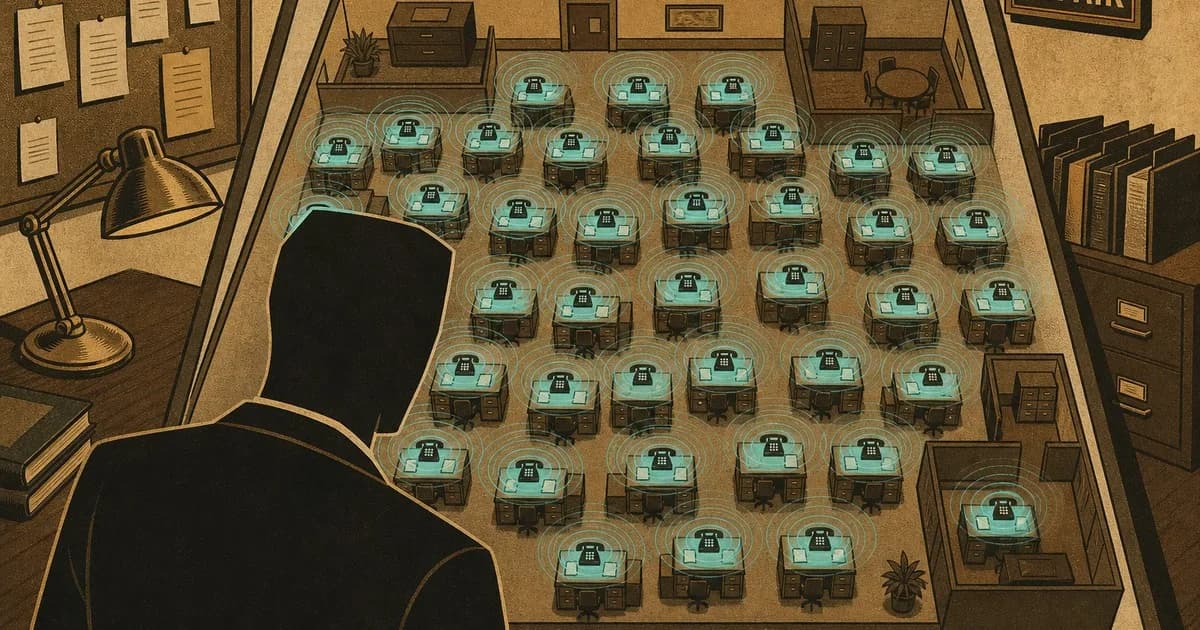
If every outbound call from your agency displays the exact same CNAM string ("ABC INSURANCE" across 100 DIDs) you are not branding your office, you are fingerprinting it. Analytics engines on the terminating side cluster traffic by CNAM, ANI pattern, and behavior (Hiya, "How carriers label spam calls"). Uniformity at scale is one of the strongest signals that a block of numbers belongs to a single outbound operation, and that signal is what drives the "Spam Likely" and "Telemarketer" tags across your roster.
This post explains why CNAM uniformity hurts you, what modern analytics engines actually do with the caller-name field, and how to restructure your caller ID strategy so agent branding works with the labeling systems instead of against them.
Why is the "strong office branding" CNAM approach now backwards?
A lot of agency owners were told (by their VoIP vendor, a sales coach, or an old call-center playbook) that every outbound number should display the office name so prospects "know who is calling." In 2014 that was fine. In 2026 it is a deliverability problem.
Here is why. When a call hits a mobile carrier, the carrier runs the ANI (the calling number) through an analytics pipeline before it ever rings. That pipeline asks questions like:
- How many distinct ANIs share this CNAM string?
- How many of those ANIs have short average call duration?
- What is the answer rate across the block?
- Are the numbers registered to the same Responsible Organization (RespOrg), sub-CSP, or reseller?
If the answer to the first question is "100+" and the answer to the rest is "bad," the entire CNAM string is now a flag. Adding a new DID to that CNAM does not give you a clean slate. It inherits the group's reputation on first use. Hiya's Q2 2025 data tracked 13.7 billion suspected spam calls flagged globally, roughly 150 million per day (Hiya Global Call Threat Report). Clustering is how engines make that scale tractable.
What does the terminating carrier actually see when my call lands?
Most agents only see two things: the number that dials out and the CNAM their VoIP provider set. The terminating carrier sees a stack:
| Layer | Field | Where it comes from |
|---|---|---|
| 1 | ANI / calling number | Your SIP trunk |
| 2 | CNAM (caller name) | LIDB dip or SIP P-Asserted-Identity |
| 3 | STIR/SHAKEN attestation | Your originating carrier (47 CFR § 64.6301) |
| 4 | Analytics verdict | Hiya, TNS, First Orion, carrier-internal |
| 5 | Display decision | Handset OS + carrier overlay |
Layers 4 and 5 are where the "Spam Likely" label lives. The analytics engine at layer 4 is pattern-matching across millions of calls per hour. A CNAM that appears on 100 numbers, all making 300+ short calls per day, will get clustered and scored as a single outbound operation no matter how "clean" any individual DID is. The Federal Communications Commission (FCC) confirms that unwanted calls remain the top consumer complaint category (FCC Stop Unwanted Robocalls), which is why analytics providers are rewarded for aggressive clustering.
Which three CNAM failure modes show up in agent rosters?
Why is literal CNAM duplication the worst case?
Every DID in the PBX is provisioned with CNAM "AGENCY NAME LLC". No variation. No agent-specific branding. This is the worst case because a single bad actor inside the office can poison all 100 numbers simultaneously.
Why do generic industry strings hurt before the first call?
CNAMs like "INSURANCE", "FINAL EXPENSE", or "MEDICARE PLAN" are red flags on their own. Analytics engines maintain category-risk weightings, and medical and insurance topics sit at the top of consumer complaint volume. Medical and prescription scams generated over 170,000 FCC complaints in FY2024 alone (FCC Top 5 Robocall Scam Complaints). If your CNAM contains one of those words, you are starting with a negative reputation score before the first call dials.
What happens when CNAM and LIDB do not match?
Your SIP P-Asserted-Identity says "JOHN SMITH AGENCY" but the LIDB record for that DID (which the carrier dips) returns "UNKNOWN" or a previous owner's name. Mismatch is interpreted as spoofing, exactly the behavior the TRACED Act directed the FCC to crack down on (FCC TRACED Act Implementation). STIR/SHAKEN attestation cannot save you if the name layer disagrees with itself.
What are agents on the ground actually reporting?
One insurance producer posting publicly to a peer community described exactly this scenario: "Pickup rate is trending down. Had a prospect tell me I was coming up as spam on his phone" (Insurance Forums thread, "Need help: Number getting flagged as spam"). That is the downstream effect of CNAM clustering. The producer's individual number inherited whatever the office block had accrued.
What does agent-appropriate CNAM variety actually look like?
Variety does not mean random. It means the CNAM layer reflects real business structure. A 50-agent office might legitimately use 5-12 distinct CNAMs mapped to teams, lines of business, or licensed individual agents. The goal is to make the traffic look like what it actually is: multiple humans in one building, not one machine with 100 phone numbers.
A reasonable structure:
| Tier | CNAM pattern | Example | # of DIDs |
|---|---|---|---|
| Individual producer | Agent first name + last initial | "SARAH M AGENT" | 1-3 |
| Team line | Team lead name or product | "JOHN K MEDICARE" | 3-8 |
| General office | Agency DBA | "HILLCREST INSURANCE" | 5-10 |
| Inbound / brand | Legal entity | "HILLCREST INS LLC" | 1-5 |
No single tier should hold more than roughly 15 DIDs under one CNAM. Once you cross that line, clustering risk compounds fast.
How do I fix an already-uniform roster without nuking reputation?
You cannot flip 100 CNAMs overnight and expect the analytics engines to forget. Reputation is sticky, and sudden mass CNAM changes are themselves a suspicious signal. A staged approach works better:
- Audit what is actually set. Half the time the CNAM you think is registered is not what the carriers dip. See our DID self-audit guide for a 10-minute check.
- Segment by age and volume. Old, high-volume DIDs with existing reputation need a gentler touch than new DIDs with no history.
- Retire the worst offenders. Any DID already labeled "Spam Likely" or "Scam Likely" under the uniform CNAM is not worth saving. Replace it.
- Introduce variety on the clean DIDs first. Let the new CNAMs accumulate their own reputation before touching numbers that still perform.
- Register each tier with the Free Caller Registry, the joint intake maintained by First Orion, Hiya, and TNS (see the launch announcement).
- Monitor weekly. The LineAudit free check surfaces CNAM drift and cluster signals across your first 5 DIDs.
How do I give each agent their own CNAM without the clustering penalty?
Agents rightly want their own name on the display. That is great for answer rates. First Orion's own case data shows branded-caller display can lift answer rates by up to 220% against unbranded baselines (First Orion INFORM case study), and personal-sounding CNAMs consistently outperform generic office branding in A/B tests. The trick is giving each licensed agent their own small pool (2-4 DIDs) under a personal CNAM, rather than layering all agents onto one shared block.
A 30-agent office this way looks like 30 micro-clusters of 2-4 DIDs each, not one 120-DID monolith. Analytics engines see humans, not a call center.
What do the technical terms in this post actually mean?
<dl> <dt>ANI</dt> <dd>Automatic Number Identification. The calling number attached to the call itself.</dd> <dt>CNAM</dt> <dd>Caller Name. Up to 15 characters stored in LIDB and retrieved by the terminating carrier.</dd> <dt>LIDB</dt> <dd>Line Information Database. The industry directory that stores caller-name data per number.</dd> <dt>RespOrg</dt> <dd>Responsible Organization. The carrier or trunk provider that holds the number administratively.</dd> <dt>P-Asserted-Identity (PAI)</dt> <dd>A SIP header carrying an asserted display name; most US mobile carriers prefer the LIDB dip.</dd> </dl>What questions do agents ask most about CNAM clustering?
Can I set a different CNAM per call, dynamically?
No. CNAM is tied to the DID in the LIDB record. You can change which DID dials, but the caller-name string for a given number is fixed until you update the LIDB entry, which takes 24 to 72 hours to propagate.
Does STIR/SHAKEN A-attestation override CNAM reputation?
No. A-attestation tells the carrier the call is not spoofed, per 47 CFR § 64.6301. It does not tell the carrier the call is wanted. A fully attested call from a bad-reputation CNAM still gets flagged.
How long does it take for a new CNAM to build reputation?
Conservatively, 30 to 60 days of normal-pattern calling. Short calls, high rejection rates, or complaint signals during that window reset the clock.
Is "Spam Likely" the same as "Scam Likely" in the display?
No. "Spam Likely" is an analytics verdict based on pattern. "Scam Likely" is a stronger verdict usually triggered by complaint volume or a crowd-sourced report (Hiya caller reputation categories). Scam is much harder to remediate. See our spam-label remediation playbook.
Will our carrier tell us if our CNAM is clustered?
Almost never. Origination carriers have no visibility into terminating-side analytics decisions. You have to monitor externally.
Does changing the LIDB name count as a reset?
No. The analytics engines track the ANI and the behavioral pattern, not just the CNAM string. Changing the name helps reduce clustering across numbers but does not wipe the individual number's history.
Should our inbound numbers use the same CNAM as outbound?
Separate them. Inbound brand numbers should be a distinct, stable CNAM tier. Outbound dialing DIDs should rotate through personal or team CNAMs. Mixing the two pulls inbound reputation down with the outbound cluster.
How many DIDs can safely share a single CNAM?
Empirically, roughly 15 before clustering risk climbs steeply. Above that threshold, analytics engines treat the block as one reputation, not a variety of distinct callers.
Does registering with the Free Caller Registry fix a clustered CNAM?
It prevents future labels more effectively than it removes current ones. Registration is the floor, not the ceiling. Pair it with per-provider disputes for existing labels.
Why does CNAM variety matter more than office branding?
Office-wide CNAM uniformity is a 2014 practice that carriers now penalize. Variety structured around real agent identities and real team boundaries looks like what it is, a legitimate agency, and the analytics engines score it accordingly.
See related posts on area-code matching and the LIDB/CNAM technical stack for how these pieces fit together.
Are you ready to see which of your DIDs are flagged?
LineAudit checks your first 5 DIDs free. You'll see exactly which numbers are flagged, mis-registered, or at risk in 30 seconds.
LineShield is operated by licensed P&C insurance agency owners, serving captive and independent agents across the U.S. Read more about our team.
How we review: every guide is drafted from carrier and analytics-partner documentation, then fact-checked against live dialer data, because reputation rules shift constantly. Additionally, we re-verify each guide when carrier behavior changes.
Corrections: if you spot an error, contact us at customerservice@theidudes.com and we will fix it promptly.