
Call Abandonment Rate: How It Wrecks Your Number Rep
Abandoned calls burn caller ID reputation faster than almost any other dialing behavior. How the analytics engines see it, and how to stay under the line.
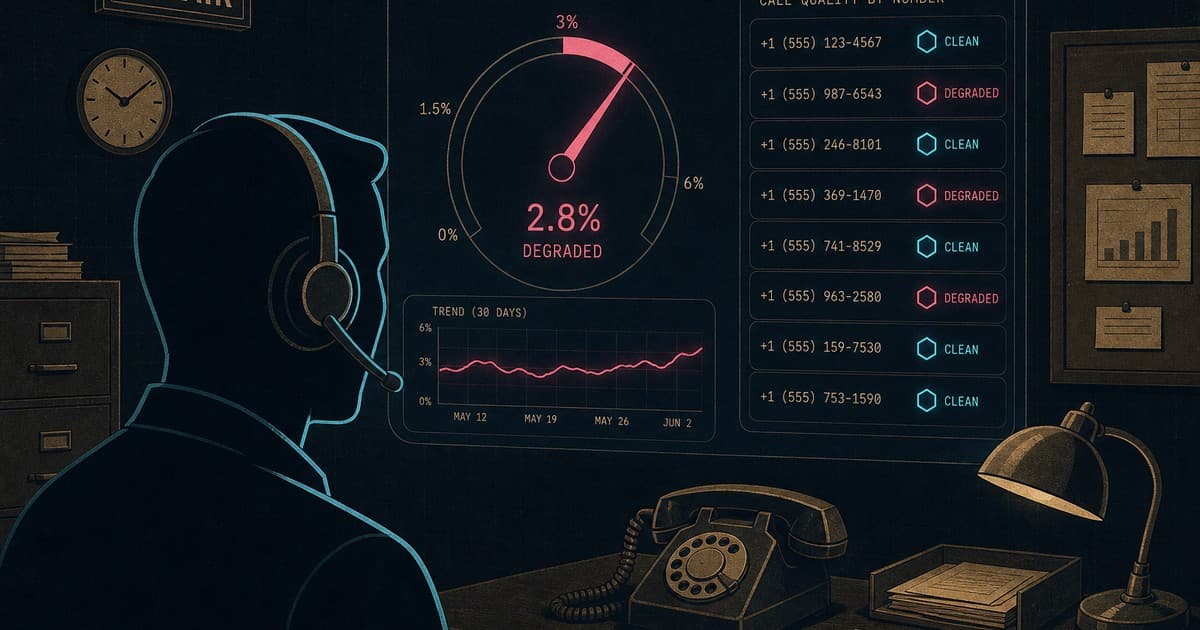
Abandoned calls are the clearest fingerprint of a predictive dialing operation. Carrier spam analytics treat them as a high-confidence signal of an outbound call center (not a single caller), and the FCC's TCPA safe harbor caps abandonment at 3% of live-answered calls per 30-day period per campaign.
What counts as an abandoned call under the FCC definition?
The FCC definition in 47 CFR § 64.1200(a)(6): a call is "abandoned" if it is answered by a live person but the dialer does not connect a live representative within two seconds of the recipient's greeting.
That two-second window is tight. Connect at 2.1 seconds: technically abandoned. The recipient perceives dead air and hangs up, or worse, waits and gets a prerecorded message without the required identification.
Three related outcomes often confused with abandonment:
| Outcome | Is It Abandonment? |
|---|---|
| Call never connects (recipient never picks up) | No |
| Recipient answers, dialer drops intentionally (no agent available) | Yes |
| Recipient answers, agent connected within 2 seconds | No |
| Recipient answers, compliant prerecorded message plays in under 2 seconds | No (if properly identified) |
| Recipient hangs up before agent connects, but within 2 seconds | Depends (measured from pickup) |
How does the 3 percent FCC abandonment rule actually work?
Under 47 CFR § 64.1200(a)(6), abandonment must not exceed 3% of live-answered calls per calling campaign, over each successive 30-day period. Exceeding 3% creates TCPA liability. Statutory damages per violating call are set at $500, trebled to $1,500 for willful violations, under 47 U.S.C. § 227(b)(3).
Key mechanics:
- The 3% is of live-answered calls, not total dials.
- Measured per campaign, not per DID or per agency.
- Rolling 30-day window.
- Compliant recorded messages within 2 seconds (with proper identification and opt-out information under FTC TSR 16 CFR § 310.4(b)(1)(iv)) are NOT abandonment.
- The safe harbor also requires the dialer to maintain records of abandonment rate calculations, available on request.
The FCC opened an October 2025 Notice of Proposed Rulemaking reconsidering aspects of the abandonment rule; operators should track that docket but assume current rules remain in force. Our guide to the FCC abandoned-call rule for insurance dialers breaks down the compliance math in full.
Why do carrier analytics flag abandonment more aggressively than the FCC rule?
The FCC rule is a compliance floor. Carrier analytics operate at a tighter threshold (often flagging campaigns at around 1% abandonment) because abandonment is the clearest fingerprint of predictive dialing at scale.
What the spam analytics engines see when abandonment runs high:
- Short-duration live-answered calls (under 5 seconds) cluster on a DID.
- The call pattern is asymmetric: dial, brief connect, drop, repeat.
- The recipient often initiates the hangup within 2-4 seconds.
- Complaint rate rises as recipients label the number as dead-air spam.
Those four signals move a DID from "commercial outbound" to "call center spam" in most analytics classifications. Labels such as "Scam Likely," "Spam Risk," or "Potential Spam" appear within 48-72 hours. TNS's 2025 Robocall Investigation Report and Hiya's State of the Call both document the near-real-time nature of modern labeling.
"Every call to a dead line inflates your abandon rate, shortens your average call duration, and generates exactly the signals that trigger spam flagging." (Close.com sales-operations guidance, reflecting the same pattern discussed across r/sales and r/telemarketing threads on predictive-dialer burn rates.)
How does the abandonment-to-reputation death spiral play out week by week?
| Stage | Behavior | Effect |
|---|---|---|
| Week 1 | Predictive ratio set aggressively (2.5:1) | Abandonment rate 4-6% |
| Week 2 | Answer rates drop as DIDs flag | Team increases dial volume |
| Week 3 | More DIDs added to pool to spread load | New DIDs fingerprint similarly, flag fast |
| Week 4 | Pool is mostly flagged, answer rate <2% | Team blames "soft market" |
| Week 5+ | Revenue drops, expensive to recover | 60+ days to rebuild clean pool |
The full cycle plays out in roughly 30 days and takes 90+ days to unwind. Prevention is dramatically cheaper than recovery.
What abandonment configuration targets correlate with stable carrier reputation?
For predictive or power dialing, the thresholds we see correlating with stable reputation:
| Metric | FCC Ceiling | Carrier-Stable Target |
|---|---|---|
| Abandonment rate (rolling 30d) | 3.0% | <1.5% |
| Abandoned calls per DID per day | No rule | <5 |
| Short-duration live calls (<6 sec) per DID per day | No rule | <15 |
| Dialer ratio (calls per available agent) | No rule | <1.8:1 for most teams |
Staying under the carrier-stable targets (not just the FCC ceiling) is what protects long-term deliverability.
Which dialer configurations actually reduce abandonment?
How tight should the dialer ratio be?
A 1.4:1 to 1.8:1 ratio for teams of 20+ concurrent producers hits a workable balance. Below 20 concurrent producers, progressive (1:1) almost always produces better net results.
Can pacing with agent-available windows close the 2-second gap?
Modern dialers can hold a call briefly in an IVR queue with identification and a compliant pre-connect message, extending the effective "live agent arrival" window without creating dead air.
Should I cap per-DID daily call volume?
Spreading volume across more DIDs at lower per-number counts reduces the short-call density that analytics engines fingerprint. Target under 300 dials per DID per producer per day for cold outbound.
How does agent-ready gating prevent abandonments?
Do not let the dialer advance the queue if agent-available headcount falls below a threshold. Better to pause for 30 seconds than generate abandonments.
What does a compliant pre-connect prerecorded message look like?
A pre-approved, fully compliant pre-connect message as a fallback lets the dialer handle occasional over-pacing without creating either an abandonment or a TCPA violation. The message must identify the caller, state the purpose, and provide opt-out. The exact requirements are at 16 CFR § 310.4(b)(1)(iv).
How should I measure abandonment to match the TCPA formula?
Dialers and call centers sometimes report "abandonment rate" calculated different ways.
TCPA-compliant calculation: abandoned calls / live-answered calls.
Misleading calculation: abandoned calls / total dials.
The second number is always lower (often 10-20x lower) and gives false confidence. If a vendor reports abandonment rate, verify the denominator.
Example: 10,000 dials, 700 live answers, 21 abandoned.
- Compliant calculation: 21 / 700 = 3.0% (at the FCC ceiling).
- Misleading calculation: 21 / 10,000 = 0.21% (looks great, is not compliant).
How do answer machine detection errors interact with abandonment?
These two failure modes look similar on a dashboard but are regulated differently.
An AMD (Answer Machine Detection) false positive (live human misclassified as voicemail, call disconnects) is generally treated as an abandonment under FCC interpretations. An AMD false negative (voicemail misclassified as live, agent connects to recording) is not abandonment but wastes producer time.
Operations running AMD should measure false positive rate explicitly and include those disconnects in abandonment calculations. A 4% AMD false positive rate can single-handedly put a campaign over the 3% ceiling.
Can reputation monitoring catch abandonment burn before the pool flags?
A campaign running 2.5% abandonment is technically compliant but usually flags DIDs within 10-14 days. By the time the producer notices call volume dropping, the pool is already burned.
Continuous DID reputation monitoring (checking display status across major carriers daily, not quarterly) catches the drift before it becomes a pool-wide problem. This is the function LineShield performs. A DID going from "displays correctly" to "Spam Likely" on even one major carrier is the earliest signal that the campaign's call pattern is looking abusive.
See the companion guides on dialer stack fundamentals and quarterly DID health.
How do I recover a pool that already burned from abandonment?
- Pause the campaign on affected DIDs immediately.
- Identify which DIDs are flagged and on which carriers.
- Retire flagged DIDs. Do not rotate them back in. Reputation recovery for severely flagged numbers is 60-180 days and often incomplete, consistent with carrier analytics vendor guidance on rehabilitation.
- Acquire replacement DIDs and warm them with conservative volume (under 50 dials per number per day for the first week).
- Adjust abandonment configuration to target <1.5% before resuming at volume.
- Monitor flag status daily for 30 days post-recovery.
Recovery is expensive. Prevention via tighter pacing is cheaper by a wide margin.
What questions do agents ask most about call abandonment?
What is the exact FCC abandonment ceiling?
3 percent of live-answered calls per campaign, measured over a rolling 30-day period, per 47 CFR § 64.1200(a)(6).
Is a 1 percent abandonment rate safe?
Safer than 3 percent, but still on the edge of carrier-stable thresholds. Target under 1.5 percent for reputation protection, not just compliance protection.
Does abandonment on toll-free numbers carry the same risk?
Yes. Carrier analytics do not treat toll-free and geographic numbers dramatically differently on abandonment, and TNS's robocall reports document flagging across both number types.
What counts as "live-answered" and does voicemail count?
Voicemail is not live-answered. AMD-classified voicemail does not go into the abandonment denominator.
Can I play a prerecorded message to avoid abandonment?
Yes, if the message meets FCC and FTC disclosure requirements (identification, purpose, opt-out) and plays within 2 seconds of pickup. Otherwise it is still abandonment.
Does the 3 percent rule apply to manual dialing?
The rule is specifically for predictive or auto-dialing systems. Manual dialing does not generate abandonment in the regulatory sense, because there is always a live agent on the line when the call is placed.
How fast does reputation damage accumulate?
DIDs running 3 percent abandonment or more typically show flag status on at least one major carrier within 7 to 14 days of campaign launch, per patterns documented in Hiya's State of the Call.
What are the statutory damages for a TCPA violation?
47 U.S.C. § 227(b)(3) authorizes $500 per violation, trebled to $1,500 for willful or knowing violations. Class actions aggregate these amounts rapidly.
What is the single biggest lever for reducing abandonment?
Tightening the dialer ratio. Moving from 2.2:1 toward 1.6:1 typically cuts abandonment substantially with a modest throughput reduction, usually a net win on deliverability.
Are you ready to see which of your DIDs are flagged?
LineAudit checks your first 5 DIDs free. You'll see exactly which numbers are flagged, mis-registered, or at risk in 30 seconds.
LineShield is operated by licensed P&C insurance agency owners, serving captive and independent agents across the U.S. Read more about our team.
How we review: every guide is drafted from carrier and analytics-partner documentation, then fact-checked against live dialer data, because reputation rules shift constantly. Additionally, we re-verify each guide when carrier behavior changes.
Corrections: if you spot an error, contact us at customerservice@theidudes.com and we will fix it promptly.