
Rotating DIDs: The Rotation Math That Stops the Flags
DID rotation is a necessary defense, but done wrong it accelerates burn. Here is a pacing, warming, and retirement strategy that actually works for agents.
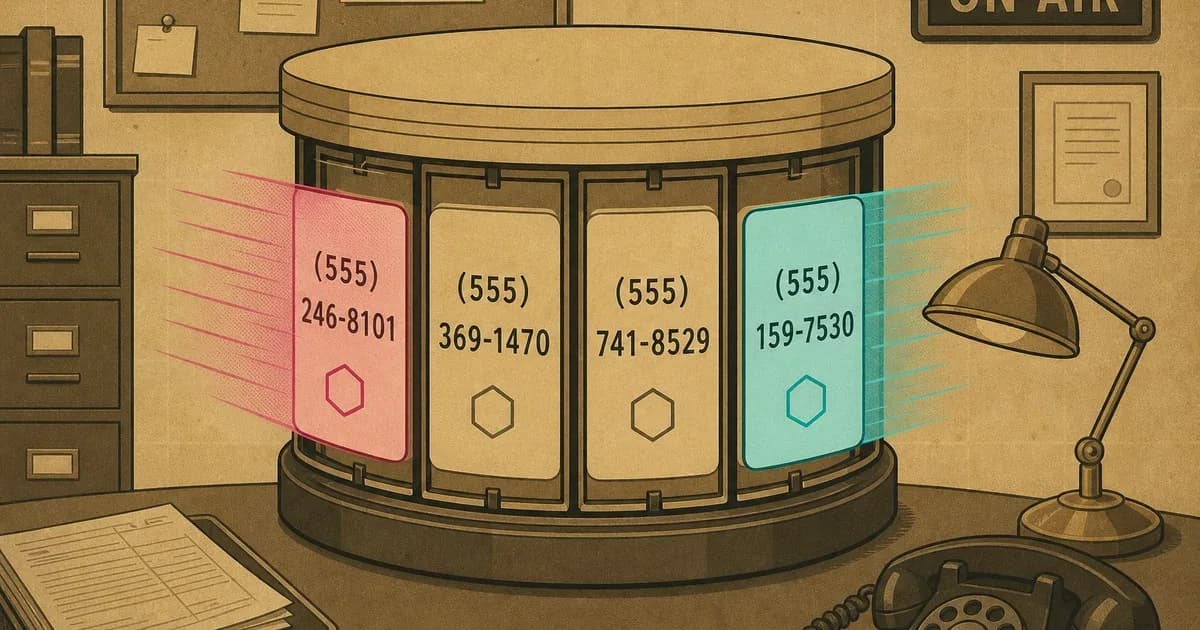
Most agencies rotate DIDs the way they rotate tires: swap the worst ones out, put the new ones in, keep driving. That approach accelerates the exact problem rotation is supposed to solve. A well-designed rotation combines warming, pacing, aging, and retirement into a cycle that preserves reputation across your pool. A poorly designed rotation burns through fresh inventory in weeks.
This post covers how to rotate DIDs without speeding up burn, the warming patterns that actually work, and when to retire a number versus remediate it.
Why does naive swap-when-flagged rotation actually accelerate burn?
The intuitive rotation is "dial from number 1 until it gets flagged, then move to number 2." That approach has three problems:
- By the time a number is visibly flagged, its analytics reputation has been degrading for days. Hiya Inc. and Transaction Network Services (TNS) both describe scoring as continuous rather than step-function (Hiya, "How carriers label spam calls"). You are pulling numbers only after significant damage.
- A freshly rotated-in number with no call history is itself a weak signal. Analytics engines treat brand-new DIDs with sudden high-volume dialing as probable spam.
- Rotating within a pool that shares CNAM, RespOrg, or behavioral pattern does not reset reputation. The cluster score follows you.
Effective rotation is proactive (swap before flags), graduated (warm before full volume), and varied (break clusters, not just numbers). A public sales-operations analysis covering over 20 million monitored dials frames the burn math bluntly: teams "running 80 dials a day experience zero issues, while teams at 150 dials are burning through numbers weekly" (Koncert, "What's the Best Dialer for Cold Calling").
What four states does every healthy DID cycle through?
A healthy rotation treats DIDs as moving through defined states:
| State | Purpose | Typical duration |
|---|---|---|
| Warming | Build initial reputation with low, varied traffic | 7-14 days |
| Active | Full production dialing at target volume | 30-90 days |
| Cooling | Reduced volume to preserve reputation | 7-14 days |
| Resting or retired | Low-touch inbound only, or released | Weeks to permanent |
At any given time, a mature pool has DIDs in each state. The ratio determines burn rate. A pool running 90% active with no warming or cooling burns fast. A pool with 60% active, 15% warming, 15% cooling, 10% resting can sustain the same dial volume for longer.
Which warming patterns actually work over 14 days?
A brand-new DID with zero history that starts dialing at 200 calls per day looks exactly like a stolen or recycled number being weaponized. Analytics engines score it accordingly. Warming is the practice of building a normal-looking call history over 1-2 weeks before the DID joins active rotation.
A reasonable warming schedule:
| Day | Calls per day | Call types | Avg duration target |
|---|---|---|---|
| 1-2 | 10-20 | Inbound if possible, internal test, known contacts | 60+ sec |
| 3-5 | 30-60 | Low-volume outbound to warm leads, callbacks | 45+ sec |
| 6-10 | 75-150 | Ramping outbound to target list segments | 30+ sec |
| 11-14 | 150-250 | Near-production volume on curated lists | 25+ sec |
| 15+ | Full production | Active rotation | (ongoing) |
Two details that matter:
- Inbound during warming: if you can route any inbound traffic to the warming DID (callback trees, voicemail callbacks, test calls from known contacts), do it. Two-way traffic is one of the strongest positive signals.
- Duration target: a warming DID with 10-second average call duration is not warming, it is pre-burning. Warm on your best lists, not your coldest.
Before adding any number to warming, check it against the FCC Reassigned Numbers Database (RND) operated by Somos Inc.. Warming a reassigned number is how you inherit someone else's reputation problem.
How does cooling extend a DID's lifetime?
Cooling is the mirror of warming. Before retiring or parking a DID, gradually reduce volume over 7-14 days. Abrupt retirement is itself suspicious. Analytics engines see a burst-then-silence pattern and score it as dialer behavior.
A cooled DID retains its reputation longer and can be brought back into rotation after a rest period without re-warming. An abruptly retired DID loses that option.
How do I size a DID pool against my dial volume?
The correct pool size depends on call volume, expected DID lifetime, and rotation cadence. Basic math:
Pool size = (Active DIDs needed) × (1 + warming_fraction + cooling_fraction + resting_fraction)
For a single agent dialing 300 calls per day at ~100 calls per DID per day, active = 3 DIDs. With 20% warming, 15% cooling, 10% resting overhead, pool size = 3 × 1.45 ≈ 5 DIDs per agent.
For a 20-agent office dialing 6,000 calls per day, pool size ≈ 100 DIDs steady-state, plus replacement inventory.
Agencies running pools significantly smaller than this math suggests are either under-dialing or over-burning. Agencies running pools much larger are usually hoarding and diluting reputation across idle inventory.
What volume pacing per DID keeps reputation stable?
Even inside "active" state, pacing matters. A DID dialed 400 times in one day and zero the next looks dialer-like. Smooth volume across business hours:
| Volume per DID per day | Reputation outlook |
|---|---|
| Under 50 | Unnecessarily low utilization, slight idle-risk |
| 50-150 | Safe range for most pools |
| 150-250 | Production range; monitor weekly |
| 250-400 | Aggressive; expect faster burn |
| Over 400 | Likely to flag within 2 weeks regardless of list quality |
Also avoid bursts. A DID that dials 200 calls in 30 minutes then goes silent for 8 hours produces a pattern signature that analytics engines lock onto. Pace outbound evenly across your dialing window.
What are operators reporting about undersized rotation pools?
A real-estate outbound community thread documents the same pattern agency owners see: operators watching legitimate rotations get ahead of flagging only when the pool is large enough to absorb natural burn (BiggerPockets forum, "Have your outbound cold call numbers been flagged as spam?"). Teams running undersized pools always catch up to the labels. Rotation only delays the problem; it does not solve under-sized inventory.
Why does breaking the cluster matter more than swapping a number?
Rotation only helps if the new DID has a genuinely different reputation profile. If all your DIDs share:
- The same CNAM
- The same originating RespOrg/sub-CSP
- The same behavioral pattern
- The same agent assignment
then a rotation inside the cluster inherits the cluster's reputation. See our CNAM strategy post for how to design CNAM variety that actually breaks clusters.
When should I retire a DID versus remediate it?
Rotation decisions are often a retire-vs-remediate call. Heuristics:
| Signal | Action |
|---|---|
| Scam Likely label | Retire; unlikely to remediate cleanly |
| Spam Likely on branded/callback number | Remediate |
| Spam Likely on pool DID | Retire and replace |
| B or C attestation under 47 CFR § 64.6301, no label yet | Fix origination, continue use |
| Multiple labels in 90 days | Retire permanently |
| Unused for 30+ days | Rest or release |
| Ownership unclear | Resolve before reusing |
The general rule: remediate branded assets, retire disposable pool DIDs.
What is the difference between resting a DID and retiring it?
Resting is temporary: a DID that is pulled from active rotation for 30-90 days while its reputation cools, then brought back into a warming cycle. Retiring is permanent.
Resting works for DIDs that were warmed correctly, performed well, and cooled cleanly before being parked. It does not work for flagged DIDs. Rest does not erase labels.
Rested DIDs should still receive occasional inbound (callback routes, IVR) to keep LIDB and activity signals fresh.
Why does DID source diversity matter as much as rotation discipline?
A pool where every DID came from the same vendor, same rate center, and same NPA-NXX block will tend to share reputation because analytics engines partially weight by block. Diversify across:
- 2-3 wholesale trunk providers (where feasible)
- Multiple rate centers per state
- Spread across NPA-NXX blocks rather than contiguous blocks
- Mix of owned-for-months and newly-ported inventory
This is operationally more complex but materially reduces cluster risk. TNS's 2024 Robocall Investigation Report highlights that inter-carrier signing rates still lag between Tier-1 and smaller carriers (TNS 2024 Robocall Investigation Report), so provider choice also affects attestation consistency, not just reputation.
What questions do agents ask most about DID rotation?
How often should I rotate?
Rotate on signals, not on a fixed schedule. Move DIDs out of active rotation when analytics scores degrade, not when the calendar hits a date. A DID performing cleanly at day 180 does not need replacement.
Should I warm every new DID?
Yes. Skipping warming for "just one" DID is how reputation problems start. Even a 3-day light warm is better than zero. Registration with the Free Caller Registry during warming establishes the baseline business signal used by Hiya, TNS, and First Orion (joint launch announcement).
Can I warm multiple DIDs in parallel?
Yes, and most pools need to. Stagger so they do not all finish warming on the same day. Otherwise a cohort of same-age DIDs all starts burning simultaneously.
What is the single biggest burn accelerator?
Short call duration. A DID with 12-second average duration will burn in days regardless of volume, pacing, or warming. Fix call duration problems (list quality, opening script, transfer readiness) before blaming rotation strategy.
How do I track DID state across the pool?
A simple spreadsheet works at small scale: DID, state, date entered state, 7-day call volume, last audit result. At larger scale, feed this data into your monitoring tool or a tracking dashboard.
Does STIR/SHAKEN change rotation strategy?
Not fundamentally. STIR/SHAKEN affects the attestation layer per 47 CFR Part 64 Subpart HH, not behavioral analytics. A well-attested DID still burns if dialed abusively.
What is a reasonable replacement rate?
For mature pools with good hygiene, 5 to 15 percent of active DIDs replaced per month. Rates above 25 percent indicate behavioral problems upstream of rotation.
Should I use toll-free as a failsafe rotation layer?
Toll-free numbers have their own reputation dynamics and lower baseline answer rates. Use them for inbound callback and brand lines, not as outbound rotation padding.
Does the Reassigned Numbers Database matter for rotation?
Yes. Checking each new DID against the FCC RND before warming prevents inheriting a prior owner's bad reputation and provides TCPA safe-harbor on consent-based calls.
Why is rotation a discipline, not a panic response?
Rotation is a discipline, not a panic response. Warm before use, pace during use, cool before retirement, and break clusters, not just numbers. Agencies that treat DIDs as a managed asset get double the life per number compared to agencies that treat them as disposables.
Related: 10-minute DID audit and spam-label remediation.
Are you ready to see which of your DIDs are flagged?
LineAudit checks your first 5 DIDs free. You'll see exactly which numbers are flagged, mis-registered, or at risk in 30 seconds.
LineShield is operated by licensed P&C insurance agency owners, serving captive and independent agents across the U.S. Read more about our team.
How we review: every guide is drafted from carrier and analytics-partner documentation, then fact-checked against live dialer data, because reputation rules shift constantly. Additionally, we re-verify each guide when carrier behavior changes.
Corrections: if you spot an error, contact us at customerservice@theidudes.com and we will fix it promptly.