
2025 Contact Rate Collapse: What Killed Your Pickups
2025 was the worst year on record for outbound answer rates. Here is what drove the collapse and what 2026 agency planning should actually account for.
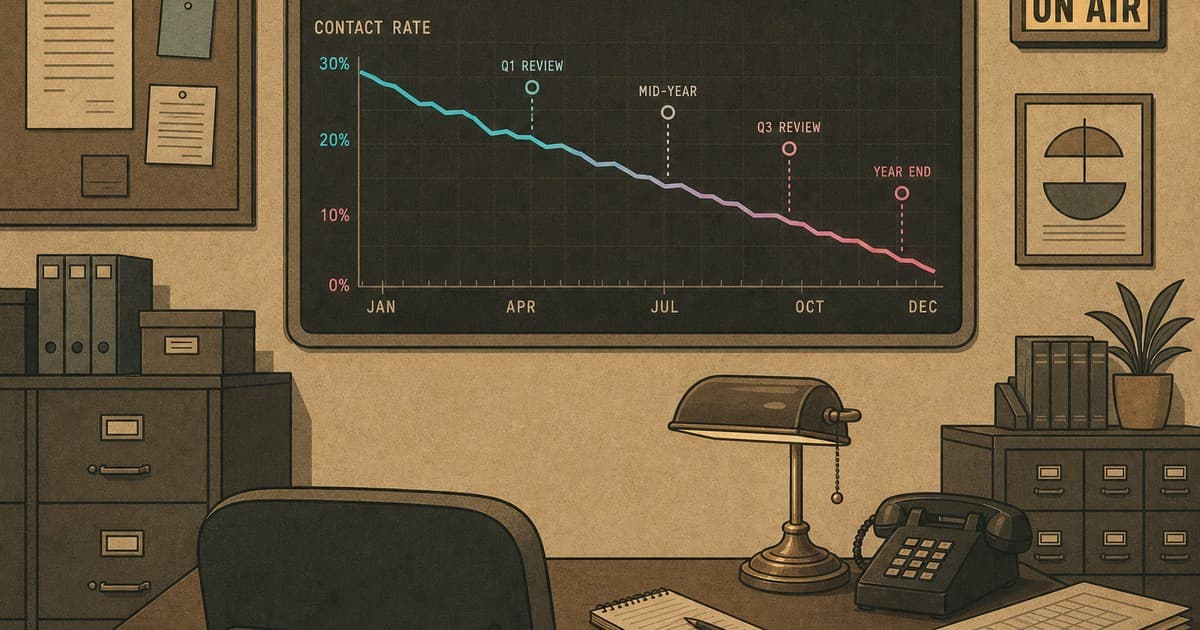
2025 saw outbound answer rates fall to their lowest documented level. The Hiya 2024 State of the Call report found that 46% of unidentified calls go unanswered, and Hiya's 2025 update reports 80% of calls from numbers people don't recognize now go unanswered. Pew Research's 2020 survey, still the most-cited public baseline, found 67% of U.S. adults do not answer cellphone calls from unknown numbers. Every filtering, reputation, and regulatory vector moved against agents in the same twelve months.
Cross-sector, the consumer-screening ratchet only moves one direction.
Why was 2025 worse for outbound than any prior year?
Insurance outbound specifically got squeezed harder than most verticals because:
- The category is explicitly flagged inside consumer filtering apps. Hiya's insurance scam-of-the-month coverage illustrates the category-level poisoning.
- Local-presence dialing lost effectiveness faster than any other industry tactic. PhoneBurner's analysis walks through why carriers caught up to rotating local DIDs.
- Regulatory pressure concentrated on lead-gen-heavy verticals. The 2023 FCC one-to-one consent rule was vacated in IMC v. FCC, but the market had already adjusted.
The agent-community view on Insurance Forums captured the mood: spam-label remediation had become a weekly operating task, not a one-time setup. Sales-side coverage from SaleSHive documents the same pattern across B2B outbound.
What actually drove the 2025 contact-rate decline?
How did branded-calling rollout reshuffle the pecking order?
AT&T Branded Call Display, T-Mobile Branded Calling, and Verizon Business Branded Calling expanded meaningfully in 2025. Carrier-reported trials cite answer-rate lifts of 30-50% for branded display. Agents with branded calling held steady. Agents without widened the gap.
How did carrier-side analytics models get more aggressive in 2025?
Analytics engines (Hiya, TNS, First Orion) tightened thresholds through 2025. Behaviors that earned a "neutral" label in January were generating "Spam Likely" labels by July. Reporting from Hiya's own blog on spam-risk warnings documents this ratchet.
How did consumer filtering apps reach critical mass?
Apple's Silence Unknown Callers, Google's Call Screen on Pixel, and third-party apps (RoboKiller, Nomorobo, Truecaller) hit adoption levels where "unknown" calls were pre-filtered before the handset rang. Hiya's 2025 reporting and TNS's survey data both reflect the trend.
How did unaudited reassignment damage compound into 2025?
Agencies that did not audit DIDs entered 2025 carrying reputation debt from 2023-2024. As models tightened, borderline numbers fell over the threshold. Churn-and-burn strategies that worked in 2022 became net negative by mid-2025. See The Hidden Cost of Reassigned Phone Numbers.
How did regulatory noise suppress marginal call volume?
Even after the Eleventh Circuit vacated one-to-one consent in January 2025, the threat had already restructured lead-gen flows. Gray-zone dialing that padded contact-rate numbers exited the market.
What does the 2025 quarter-by-quarter answer-rate decline look like?
Ranges below are synthesized from Hiya public reporting, Pew baseline, and operational peer data. Treat as directional, not authoritative.
| Quarter | Industry answer rate (cold outbound) | Consumer "don't answer unknown" rate |
|---|---|---|
| Q4 2024 | 9-11% | ~67% (Pew 2020 baseline) |
| Q1 2025 | 8-10% | rising |
| Q2 2025 | 7-9% | rising |
| Q3 2025 | 5-8% | rising |
| Q4 2025 | 4-7% | ~80% of unknown-number calls unanswered (Hiya 2025) |
What did the winning cohort of agencies do differently in 2025?
Agencies that held flat or grew contact rate in 2025 had four things in common:
- Invested in branded calling. For volume above roughly a few thousand calls/day, verified branded display paid back within a quarter.
- Ran continuous DID audits. Weekly reputation checks, aggressive retirement of flagged numbers, disciplined CNAM registration.
- Shrunk the DID pool. Counter-intuitive but consistent: firms that went from hundreds of DIDs to dozens (while aging and registering them properly) outperformed churn-and-burn peers.
- Rebuilt consent at the source. Moved upstream in lead acquisition so every call had a clean consent record and a fresh RND check.
For implementation, see Rotating DIDs Without Getting Burned and Setting Up a Compliant Outbound Call Strategy for the New Year.
What should 2026 outbound planning account for?
The collapse did not bottom out in Q4 2025.
- Answer-rate floor. Model contact rate at ~70% of Q4 2025 actuals, not 2024 averages.
- DID costs will climb. Clean numbers are in higher demand; expect 20-40% price increases on aged, carrier-verified DIDs.
- Branded calling becomes table stakes. At any meaningful volume, enrolling in AT&T Branded Call Display, T-Mobile Branded Calling, or First Orion branded is 2026's highest-ROI project.
- Multi-channel is not optional. Single-channel outbound agencies will not compete. Email, SMS with its own consent regime, and warm-transfer partnerships need to stand up in Q1.
What practices should I retire heading into 2026?
- Stop blaming the dialer vendor. Most 2025 decline was externalities.
- Stop rotating through massive pools of un-vetted DIDs. The math broke.
- Stop treating CNAM as set-and-forget. It drifts.
- Stop building consent flows around federal law alone. States are where the risk is.
What questions do agents ask most about the 2025 contact-rate collapse?
Is the contact-rate collapse permanent?
The consumer-behavior piece is permanent. Per Hiya 2025, call-screening adoption is a ratchet. The reputation and filtering piece is manageable if DID hygiene and branded calling are treated as core infrastructure. Returning to 2022 contact rates is not a realistic goal.
What is a reasonable answer-rate target for 2026?
For unbranded cold outbound, plan on 4 to 8 percent. For branded, verified outbound to warm leads, 15 to 25 percent remains achievable. Below the unbranded floor, the issue is DID reputation, not environment.
How did the one-to-one consent vacatur affect contact rates?
Neutral to negative. The threat already forced consent-flow changes. The IMC v. FCC vacatur did not reverse the market's move away from shared consent. Meanwhile, state mini-TCPAs kept tightening.
How much did Apple's Silence Unknown Callers actually cost us?
Hard to isolate. Hiya and Pew data suggest consumer-side filtering (handset + app + carrier) collectively removed roughly 10 to 15 percentage points of answer opportunity over 2022 to 2025. Silence Unknown is one factor among several.
Is local-presence dialing dead?
Not dead, but declining. PhoneBurner's analysis documents how analytics engines got better at flagging pattern-dialed local numbers. Local-presence still beats non-local for handset-answered calls, but the gap narrowed.
What is the single best investment for 2026?
For most agencies: branded calling enrollment plus continuous DID audits. The closest thing to a quick win in the current environment.
How bad is Q1 2026 going to be?
Seasonally, Q1 is usually the strongest outbound quarter. Against 2025's depressed baseline, Q1 2026 will likely feel like mild recovery. Do not mistake it for trend reversal. Structural decline continues underneath seasonal lift.
What does the Hiya 2025 data say about unidentified calls?
Hiya reports that 80 percent of calls from unrecognized numbers now go unanswered, 48 percent of consumers never answer unidentified calls, and almost half of consumers say spam volume increased year-over-year. Those figures are the clearest public benchmark for 2025 consumer behavior.
Are you ready to see which of your DIDs are flagged?
LineAudit checks your first 5 DIDs free. You'll see exactly which numbers are flagged, mis-registered, or at risk in 30 seconds.
LineShield is operated by licensed P&C insurance agency owners, serving captive and independent agents across the U.S. Read more about our team.
How we review: every guide is drafted from carrier and analytics-partner documentation, then fact-checked against live dialer data, because reputation rules shift constantly. Additionally, we re-verify each guide when carrier behavior changes.
Corrections: if you spot an error, contact us at customerservice@theidudes.com and we will fix it promptly.