
DNC Scrubbing 2026: Rules Insurance Agencies Get Fined On
Insurance agents: scrub every list against the federal DNC registry every 31 days, eleven state registries, and your internal opt-out list before each dial.
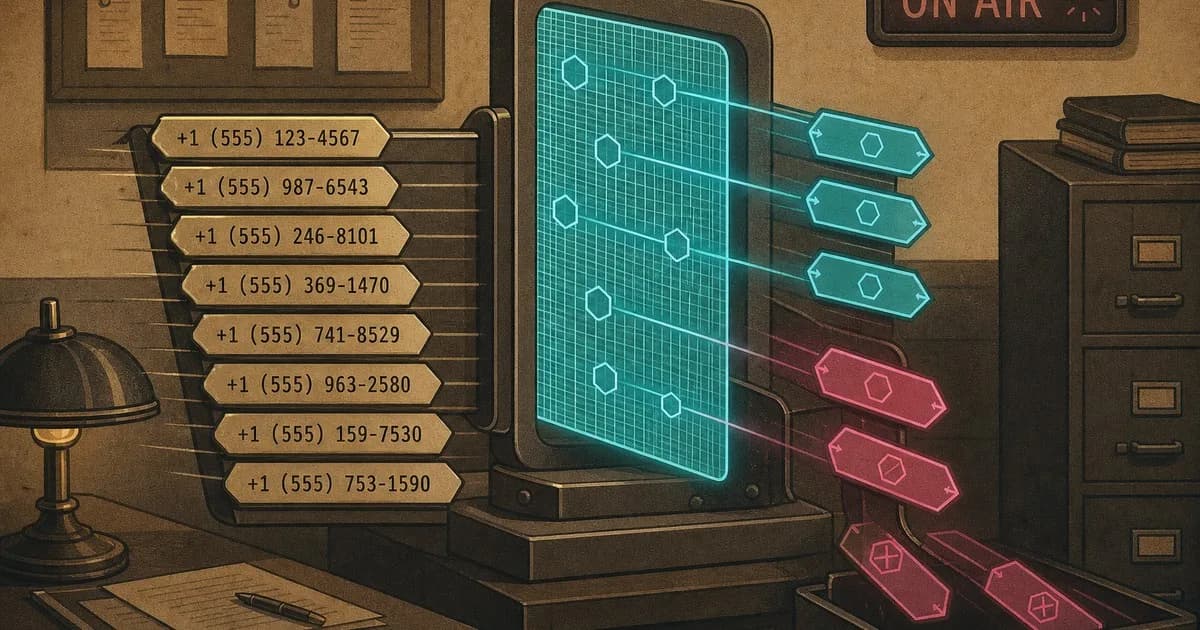
Compliance isn't a department; it's a dialer setting. The Federal Trade Commission requires every telemarketer to scrub call lists against the National Do Not Call Registry at least once every 31 days, and that clock resets with every new number added to the registry. Miss the window and your dialer is calling protected consumers within a calendar month, each one a separate violation. With robocall volume hitting 4.2 billion calls in March 2026 alone and regulators sharpening enforcement, DNC scrubbing has moved from checkbox compliance to an operational imperative for every agency running outbound. Here's exactly how to build a scrubbing framework that keeps your dialers clean and your agency out of the penalty column.
What three DNC layers does every agency dialer have to scrub against?
DNC compliance isn't one list. It's a stack of three overlapping requirements, and missing any one of them opens exposure.
What does the federal National Do Not Call Registry actually require?
The FTC's Telemarketing Sales Rule (TSR), codified at 16 CFR Part 310, requires every seller and telemarketer to access the National DNC Registry and scrub calling lists against it. The core rules:
- Scrub every 31 days minimum. The FTC's compliance FAQ states plainly: "organizations are required to search the registry at least every 31 days." Numbers are added daily. A list scrubbed on January 1st is potentially out of date by January 15th.
- Five area codes are free. After the first five, the FTC charges $82 per area code per year, capped at $22,626 annually. For an agency calling nationally, budget for the cap.
- The registry applies to texts too. The FCC has codified that DNC Registry protections apply to text messages as "calls" under the TCPA. Scrubbing before SMS campaigns is equally required.
The penalty for getting this wrong is not hypothetical. The FTC's Telemarketing Sales Rule carries a civil penalty of up to $53,088 per violation as of the 2025 inflation adjustment. That's per call. A dialer running 100 calls per producer per day through an unscrubbed list for a week generates hundreds of potential violations before anyone notices.
Which states maintain their own DNC registry in addition to the federal one?
The federal registry is not the end of the story. As of 2025, eleven states maintain their own separate Do Not Call lists in addition to the federal registry. These include states with large populations and aggressive attorneys general: Florida, Texas, and Indiana among them. Each state list has its own access process, its own update cadence, and its own penalty structure. A call that's clean at the federal level can still be a state violation.
The operational implication: your scrubbing tool must integrate with all eleven state registries, not just the federal one. Most dialer-native DNC integrations only cover the federal list by default. State coverage is normally an add-on or requires a third-party compliance platform. If you're an agency calling in multiple states, verify your coverage explicitly. Don't assume.
How does the internal company-specific DNC list differ from the federal one?
The TSR also requires every seller to maintain an internal do-not-call list. When a consumer asks not to be called again (whether during a live call, via voicemail, or through your website) you must add them to your company-specific suppression list and honor that request. Importantly, unlike federal DNC entries, which can be overridden by an established business relationship or prior express written consent, a company-specific opt-out is absolute: even if you have an EBR or prior consent, a consumer who asks not to be called must not be called again.
Industry best practice is to process internal opt-outs immediately (same call, or within the same business day) and to maintain a single centralized suppression list that feeds into every outbound campaign. Multiple dialers, multiple lead sources, one internal DNC list. This sounds obvious but is the most common gap in agency compliance: producer Bob takes an opt-out on his cell phone and never logs it. Two weeks later, producer Sarah calls the same number from a recycled lead. That's a violation.
When does an Established Business Relationship exempt me from federal DNC?
Not every outbound call requires DNC scrubbing. The TSR provides an exemption for calls made to consumers with whom you have an Established Business Relationship (EBR). The rules:
- 18 months after a purchase or payment. If a consumer bought a policy or made a payment within the last 18 months, you can call even if they're on the federal DNC registry, unless they've asked you specifically not to.
- 3 months after an inquiry. If someone submitted a quote request, completed a web form, or called your agency asking about coverage, you have a three-month calling window.
- EBR is voided by opt-out. The moment a consumer tells you to stop calling, the EBR exemption evaporates. No grace period, no "we already had a relationship."
For insurance agencies, the EBR exemption is practically important because it covers the bulk of your book: current policyholders, recent lapses, and active inbound leads. But the exemption can be a trap if you don't track it rigorously. EBR status is tied to dates (purchase date, inquiry date, payment date) and many agencies don't have those dates cleanly mapped to phone numbers in their CRM. As we discussed in our guide to reassigned phone numbers and the hidden cost of stale data, EBR does not travel with the number when it's reassigned.
Where does the Reassigned Numbers Database fit into scrub workflow?
Consent under the TCPA is tied to the person, not the phone number. When a number is reassigned, your EBR with the prior subscriber does not extend to the new owner. This is what the FCC's Reassigned Numbers Database (RND) addresses. Carriers now wait a minimum of 45 days between permanent disconnection and reassignment, and the RND allows callers to check whether a number has been reassigned since the date of their last confirmed consent.
For an agency's compliance workflow, the RND adds an extra step to the scrub: after checking federal DNC, state DNC, and internal DNC, also check the RND for any number where your consent or EBR is more than 45 days old. The RND operates on a subscription basis with per-query fees, fractions of a cent per lookup at high volume. Most agencies integrate it through their compliance platform rather than querying directly.
What does a pre-dial scrub workflow look like, step by step?
The scrub must happen before the dialer connects. Post-dial scrubbing (checking compliance after the call has already happened) is not compliance. The workflow:
- Lead ingested into CRM → triggered by web form, purchased list, referral, or aged lead recycle
- Automated scrub against federal DNC → API call to DNC registry or compliance platform
- Automated scrub against state DNC lists → for leads in states with separate registries
- Automated scrub against internal DNC → your company-specific suppression list
- RND check (if consent > 45 days old) → verify number hasn't been reassigned
- Litigator/known-plaintiff scrub → optional but strongly recommended; platforms like DNC.com and PhoneBurner's DNC integration include known TCPA litigator databases
- Cleared for dialing → only after passing all six gates
For agencies running high-volume outbound (500+ dials per producer per day across multiple producers) this workflow cannot be manual. It must be API-driven and baked into the dialer platform. Modern compliance integrations from Convoso, PhoneBurner, and dedicated platforms like DNC.com and Gryphon.ai provide real-time API scrubbing that checks numbers against all required lists before the dialer places the call.
How do CRM, compliance API, and dialer connect for automated scrubbing?
An automated DNC scrubbing implementation needs to connect three systems:
What does the CRM-to-compliance-to-dialer pipeline actually look like?
The compliance layer sits between your lead source and your dialer. When a lead enters the CRM, it triggers a scrubbing API call that returns a pass/fail decision. If pass, the lead routes to the dialer queue. If fail, the lead is suppressed with a reason code (federal DNC, state DNC, internal opt-out, or RND reassignment).
Key technical considerations:
- API latency matters. A scrubbing call that takes two seconds isn't viable for a predictive dialer pacing at sub-second intervals. Most compliance APIs return results in 200-500ms.
- Batch processing for list uploads. When uploading a new lead list of 10,000 records, batch-scrub before ingestion rather than checking one-by-one during dialing. This is available via CSV upload in most compliance platforms.
- Audit trail is not optional. Every scrub decision must be logged with a timestamp, the lists checked, and the result. If you get a demand letter or a TCPA suit, the defense is "we scrubbed this number against these lists on this date and got a pass." No log = no defense. This is the same audit discipline we recommend in our guide to STIR/SHAKEN attestation for insurance agents. Compliance without records isn't compliance.
What does a full DNC compliance stack cost per year?
DNC compliance infrastructure is modest relative to the exposure it prevents. A breakdown:
| Component | Approximate Annual Cost |
|---|---|
| Federal DNC access (5+ area codes) | $410-$22,626 (FTC subscription) |
| State DNC list access | Varies by state; $0-$500 per state |
| Compliance platform (DNC.com, Gryphon, etc.) | $2,400-$12,000/year (tiered by volume) |
| RND subscription | Per-query pricing; ~$500-$2,000/year at agency volume |
| Internal DNC management | Usually included in compliance platform |
Total: roughly $5,000-$25,000/year depending on calling footprint and volume. Context: one TCPA statutory damages claim for 10 violations at $500 each is $5,000, and that's baseline, before trebling for willful violations. The math on scrubbing infrastructure is not complicated.
Why is the 31-day scrub cadence a ceiling, not a target?
The 31-day requirement is a regulatory ceiling, not a best practice. Numbers are added to the federal registry continuously. A number registered on day 15 of your 31-day cycle goes uncaptured for 16 days before your next scrub. For high-volume campaigns, a shorter cadence dramatically reduces exposure:
- Weekly scrub (every 7 days): maximum uncaptured window drops from 30 days to 6
- Pre-campaign scrub (scrub immediately before every campaign upload): fresh list, zero uncaptured additions
- Real-time pre-dial scrub (API check before every call): effectively zero-gap
For agencies running daily outbound campaigns, pre-campaign scrubbing plus a weekly full-list refresh is the practical gold standard. It balances API costs against compliance exposure and doesn't require real-time infrastructure.
Which DNC compliance gaps show up most often in agency audits?
Having reviewed dialer compliance postures across dozens of insurance agency operations, these are the gaps that surface most frequently:
Why do most agencies have state DNC blind spots?
Most agencies scrub against the federal list. Almost none scrub all eleven state lists. If you call in Florida, Texas, Indiana, Louisiana, or any of the other states with separate registries, verify state coverage with your compliance provider. If you're using your dialer's built-in DNC setting, that's almost certainly federal-only.
Why are recycled leads without re-scrub the top violation vector?
A lead purchased six months ago, scrubbed once, and recycled into a new campaign has been sitting unscrubbed for 180 days. Five missed scrub cycles. Recycled leads need fresh scrubs, full stop. This is the most common violation vector in insurance agency outbound because old leads live in CRM segments that nobody thinks to re-verify.
What is the risk of producer bring-your-own lists?
Book-of-business transfers, producer-hired-from-competitor scenarios, and "I had great success with this list from my old agency": all of these introduce unscanned phone numbers into the dialer. Every external list must pass through the full scrub workflow before it touches the dialer, regardless of who brought it in.
Why must internal opt-outs feed every campaign from a single list?
For agencies with multiple producers running separate dialer sessions, internal DNC compliance only works if there's one suppression list feeding every campaign. An opt-out taken by Producer A must block Producer B's dialer from calling the same number, and that requires integration. A spreadsheet on a shared drive does not count.
How are consent gaps fueling the TCPA class action surge?
TCPA class actions have surged. 2,788 TCPA cases were filed in 2024, up 67 percent from 2023. Insurance agencies are increasingly being named as defendants, not because they're running scam operations, but because their compliance workflows have gaps that class action firms systematically exploit. In our deep dive on TCPA consent rules for 2026, we walked through the specific consent documentation requirements that hold up under scrutiny.
How does clean DNC compliance act as a competitive advantage?
The agencies that treat DNC compliance as a dialer setting (not a legal department function) gain two advantages.
First, they're protected. With a properly configured compliance stack, the scrubbing happens automatically. Producers dial with confidence. The agency principal doesn't wake up to a demand letter.
Second, clean compliance drives better contact rates. Carriers' spam-detection algorithms correlate high-complaint call patterns with spam-like behavior. A compliant operation generates fewer complaints. Fewer complaints means a healthier caller-ID reputation, less spam flagging, and higher answer rates: the same connection-rate pattern we explored in our analysis of why insurance agents have the worst contact rates in B2C sales.
DNC compliance and deliverability are increasingly the same conversation. The agencies that connect both systems (scrubbing plus reputation management) are the ones that get through.
What does a complete DNC scrubbing compliance checklist cover?
- Federal DNC registry subscription active (check area code coverage)
- All 11 state DNC lists integrated (verify; don't assume)
- Internal DNC list centralized and feeding all dialer campaigns
- RND integration active for any consent older than 45 days
- Litigator/known-plaintiff database active in compliance platform
- Scrub cadence confirmed (weekly minimum; pre-campaign strongly recommended)
- Recycled lead re-scrub protocol documented and automated
- Producer onboarded lists required to pass full scrub before dialer access
- Scrub audit log enabled with timestamps on every decision
- Quarterly compliance review scheduled with documentation of all lists, cadences, and exceptions
This isn't a one-time setup. DNC compliance is a continuous process, and the regulatory environment is getting stricter, not looser. Build the workflow once, automate it, audit it quarterly, and your dialers will operate inside the lines without anyone having to think about it.
LineShield is operated by licensed P&C insurance agency owners, serving captive and independent agents across the U.S. Read more about our team.
How we review: every guide is drafted from carrier and analytics-partner documentation, then fact-checked against live dialer data, because reputation rules shift constantly. Additionally, we re-verify each guide when carrier behavior changes.
Corrections: if you spot an error, contact us at customerservice@theidudes.com and we will fix it promptly.