
What Is TNS Call Guardian and How Does It Flag Calls?
TNS Call Guardian is a carrier-side analytics engine that profiles 1.9 billion numbers and flags spoofed robocalls. Here is how it works for agency outbound.
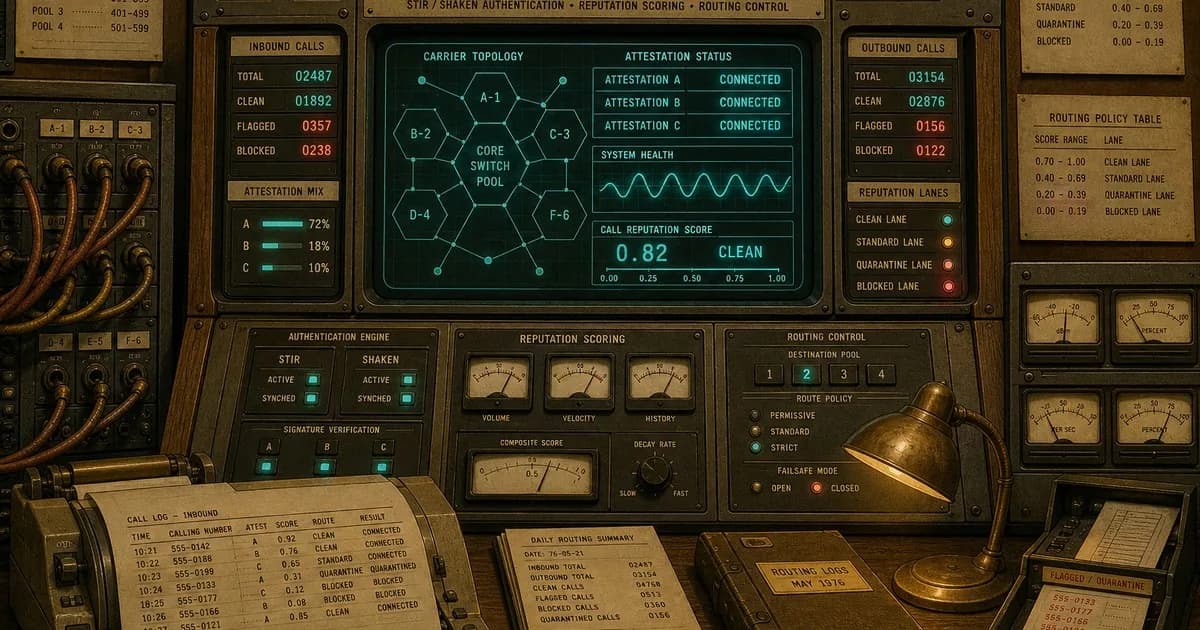
Every time an agency number dials out, a carrier has already profiled it. The decision about what the prospect sees is made before the phone rings. That engine is TNS Call Guardian. Understanding how it scores a number is the fastest way to stop a clean DID from drifting into a "Spam Likely" banner on /blog/scam-likely-why-outbound-calls-get-flagged.
TL;DR
TNS Call Guardian is the reputation engine behind a large share of North American spam labeling. It scores more than 1.9 billion telephone numbers in real time. The engine layers STIR/SHAKEN attestation, Do Not Originate lists, invalid-number screening, and machine-learning analytics. A number gets flagged when its velocity, answer rate, and attestation level cross a threshold carriers trust. The path back is to fix those signals at the source, not argue with the label.
Key Takeaways
- TNS Call Guardian profiles 1.9 billion numbers and analyzes 1.5 billion call events daily across 500 operators.
- The engine layers Do Not Originate lists, invalid-number screening, STIR/SHAKEN attestation, and machine learning.
- Only 85 percent of Tier-1 traffic was STIR/SHAKEN signed in 2025, and 17.5 percent among smaller carriers.
- Robocall volume sits near 3.9 billion calls a month, so carrier scoring stays aggressive on high-velocity traffic.
What exactly does TNS Call Guardian do?
TNS Call Guardian is a carrier-side analytics platform. It builds a reputation profile for every number that transits a participating carrier's network. Then it decides in real time whether a call is legitimate or a spoofed robocall TNS.
The scale is what matters for an operator. The engine analyzes over 1.5 billion call events each day across more than 500 carriers. It holds caller reputation profiles on more than 1.9 billion telephone numbers TNS. Every outbound DID your dialer uses sits inside that set.
You do not opt in to being scored. The receiving carrier has already subscribed. Your number is in the model the moment it first transits their network.
How does the scoring actually work?
Call Guardian is not a single check. It is a layered stack. The platform combines Do Not Originate data, invalid and unassigned number screening, STIR/SHAKEN attestation, and machine-learning analytics TNS.
Each layer catches a different failure. Do Not Originate lists catch spoofed caller IDs, the most common fraud pattern. STIR/SHAKEN attestation tells the engine whether the call was signed at the source. The machine-learning layer weights velocity, answer ratio, and call duration to flag bulk dialing.
Scoring happens at call setup, in milliseconds. The label decision lands before the phone rings on the prospect's end TNS.
Where does STIR/SHAKEN fit into the flag?
STIR/SHAKEN is the caller ID authentication framework carriers deploy to verify that a calling number is legitimate. Call Guardian integrates those attestation parameters directly into its reputation score TNS.
The framework uses three attestation levels. A-level means the carrier knows the customer and verified the number. B-level means the customer is known but the number was not verified. C-level means there is no authenticated relationship at all.
Call Guardian folds that result into its reputation score. A call with A-level attestation reads as lower risk than B or C TNS.
But signing alone has limits. The 2026 TNS Robocall Investigation Report found a wide gap. Among Tier-1 carriers, 85 percent of traffic was signed with STIR/SHAKEN in 2025, and 93 percent of that was A-level TNS. Among smaller carriers, the signed share was only 17.5 percent.
Improper attestation is another problem. Up to 13 percent of invalid-number traffic was still signed at A-level. As much as 20 percent of signed traffic showed over-attestation of invalid numbers TNS. An A-level mark is one signal, not a guarantee.
Why is the scoring so aggressive right now?
The raw volume is still enormous. YouMail's Robocall Index recorded 3.9 billion robocalls in August 2026 alone. That is about 125 million per day and nearly 12 calls per person YouMail. Every engine is tuned to suppress anything that looks like bulk traffic.
Consumer behavior pushes from the other side. Hiya's State of the Call reports that 86 percent of unknown calls go unanswered Hiya. Nearly nine in ten unknown calls are ignored. So carriers label aggressively and err toward blocking.
Complaints are not fading either. The FTC received over 2 million Do Not Call complaints in fiscal year 2024. The registry held more than 253 million active registrations FTC. Every complaint feeds the same signals Call Guardian consumes.
How is TNS Call Guardian different from Hiya and First Orion?
All three do carrier-side reputation scoring, but they sit in different places. We break down all three engines in /blog/hiya-tns-firstorion-spam-labels. TNS Call Guardian sits closest to the carrier's call-routing infrastructure. It powers labeling for regional carriers and four of the top five US wireless networks TNS.
Hiya and First Orion lean more on consumer apps. TNS positions Call Guardian as a network-level layer carriers plug into their switching. Each engine weights signals differently. Each carrier trusts a different combination.
So a number can look clean on one engine and flagged on another. That is why monitoring a single vendor is not enough. A number not flagged by Call Guardian can still carry a Hiya or First Orion label.
What can an agency do about a Call Guardian flag?
Recovery runs through the same signals the engine reads. First, confirm your carrier signs outbound traffic at A-level and can verify your right to every DID. The /blog/stir-shaken-attestation-levels-insurance-agents guide explains A, B, and C in detail TNS.
Second, fix the behavior. The machine-learning layer reacts to velocity and short calls. Slow the flagged number's cadence. Improve list quality so more calls connect. Rest the number rather than dialing through a bad patch TNS.
There is no dispute button that resets the score. Call Guardian maintains a continuous profile. It moves the way your calling behavior moves. Resting and warming the DID is the only recovery that sticks.
What questions do agents ask most about TNS Call Guardian?
Is TNS Call Guardian a carrier or an analytics vendor?
TNS is an analytics and network-services vendor, not a wireless carrier. Call Guardian is its reputation product, which carriers subscribe to for spam labeling on their networks TNS.
Does A-level attestation keep my number from being flagged?
Not by itself. A-level lowers risk, but TNS has documented improper attestation, including invalid numbers signed at A-level TNS. Signing alone does not guarantee a clean label.
How many calls does TNS Call Guardian analyze in a day?
It analyzes more than 1.5 billion call events daily across over 500 operators. It profiles more than 1.9 billion telephone numbers TNS. Your outbound DID is already in that set.
Can I submit a dispute to remove a Call Guardian flag?
There is no universal form that resets the score. The profile reacts to your live calling behavior. Practical recovery means fixing attestation, list quality, and velocity TNS.
Does Call Guardian read my subscriber contacts or call content?
No. TNS states the platform does not need access to subscriber contacts. It protects subscriber privacy while still generating the analytics carriers use TNS.
Sources cited in this analysis?
- TNS Call Guardian product page: https://communications.tnsi.com/tns-call-guardian
- TNS 2026 Robocall Report, Going Further Than STIR/SHAKEN: https://tnsi.com/resource/com/tns-2026-robocall-report-going-further-than-stir-shaken-blog/
- Buckeye Broadband Taps TNS Call Guardian: https://tnsi.com/resource/com/buckeye-broadband-taps-tns-call-guardian-in-battle-against-robocalls-press-release/
- FTC National Do Not Call Registry Data Book FY2024: https://www.ftc.gov/reports/national-do-not-call-registry-data-book-fiscal-year-2024
- YouMail Robocall Index: https://robocallindex.com/
- Hiya State of the Call: https://www.hiya.com/state-of-the-call
LineShield is operated by licensed P&C insurance agency owners, serving captive and independent agents across the U.S. Read more about our team.
How we review: every guide is drafted from carrier and analytics-partner documentation, then fact-checked against live dialer data, because reputation rules shift constantly. Additionally, we re-verify each guide when carrier behavior changes.
Corrections: if you spot an error, contact us at customerservice@theidudes.com and we will fix it promptly.