
Line Information Database: Fix Your Caller ID Name
The Line Information Database (LIDB) stores the name that displays on your caller ID. Learn who owns your record, why it is wrong, and how to correct it.
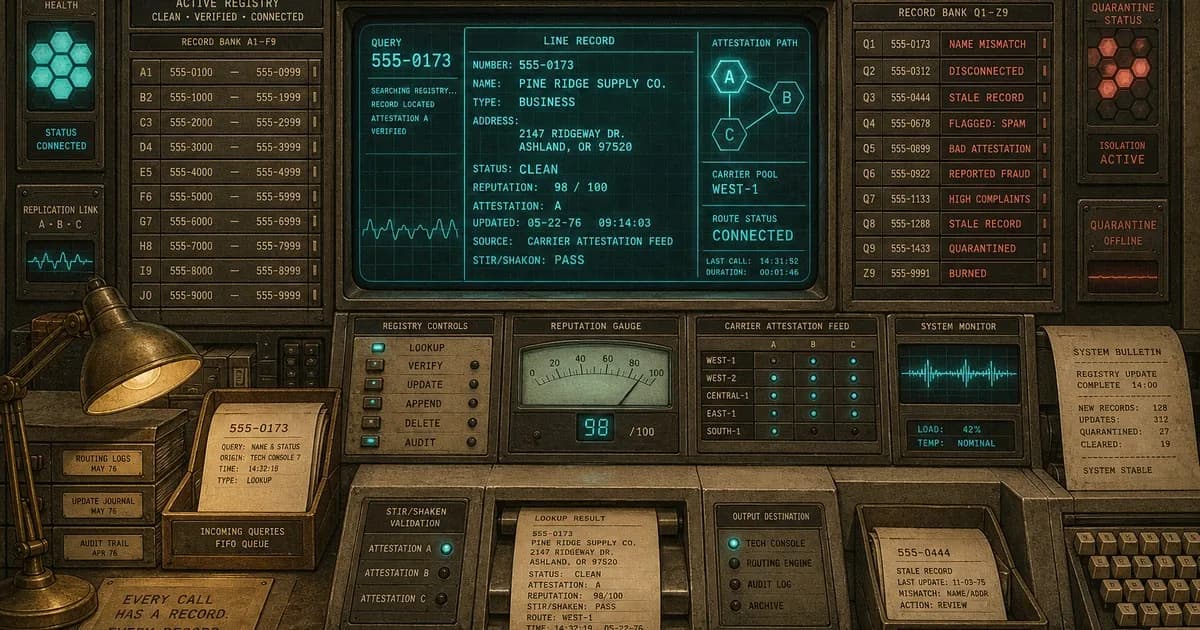
Here is the thing most agency owners never learn until it costs them answers: your caller ID name is not carried along with your call. The receiving carrier looks it up. That lookup lands in the Line Information Database, and the record it finds there is the name your prospect sees. If the record is empty, stale, or wrong, your carefully built agency name never reaches the handset.
TL;DR
The Line Information Database is the shared registry that powers caller ID name lookups across North American carriers. Your record belongs to whoever owns your numbers, usually your trunk or phone provider. A wrong or missing name is fixed by asking that provider to correct your record, then waiting for propagation and re-checking the dip. Clean it once and every outbound call inherits the fix.
Key Takeaways
- The receiving carrier looks up your name in the Line Information Database on every call.
- Your caller ID name record is the Line Information Database that caller ID name runs a dip against.
- A missing record shows a number only, while a stale record shows the prior owner's name.
- Corrections usually propagate across carriers within three days, and sometimes longer.
- Verify the dip on multiple carriers, because one carrier may still cache an old record.
What is the Line Information Database and what does it store?
The Line Information Database (LIDB) is a collection of commercial databases that U.S. and Canadian phone companies use to store and retrieve the names shown by caller ID. Bandwidth describes it plainly as the Line Information Database that caller ID name runs a dip against. When a call arrives at the terminating carrier, the carrier runs that lookup to fetch the name and present it alongside the number.
It is not one physical database. It is a distributed set of regional carrier-run databases that stay in sync. On the dominant mobile path, the terminating carrier ignores whatever display name your dialer stuffed into the call and runs the LIDB lookup instead. TransNexus confirms the CNAM dip is done by the terminating service provider, not by the caller. When you update a record, the other carriers reach it through that shared, synchronized store.
Why is my caller ID name wrong or missing?
A wrong name almost always has one of four causes. The record is empty, so your prospects see a bare number. The record still holds a prior owner's name because the number was reassigned and the new name never overwrote it. The record is truncated or formatted wrong, so a partial or garbled name renders. Or the record has not yet propagated, so one carrier shows the fix while another still shows the old data.
CNAM records do not guarantee a correct name on every carrier either. Numeracle warns that the same phone number can return different names depending on which carrier terminates the call, because each terminating provider dips its own cached or aggregated copy. That is why a number can look clean on one phone and wrong on another in the same week.
Who owns and writes my Line Information Database record?
Your record is written by the carrier or service provider that administers your number, usually your phone or trunk provider writing on your behalf. It is not something you edit directly. Numeracle's guidance is simple: contact your service provider and request your name be associated with your number. That single request resolves most wrong-name problems.
Wholesale trunk providers often buy numbers upstream, so the record can sit one or two providers deep. If your direct provider cannot write the record, ask which upstream carrier owns the number and route the correction request there. This chain is the reason some agencies chase a wrong name for weeks without finding the actual owner.
How long does a Line Information Database change take to show up?
Propagation is not instant, and it is not uniform. A typical update reaches the carriers within about three days of submission, but a cached entry at an individual carrier can linger longer. TransNexus notes that some providers cache CNAM data and refresh it periodically, which is why the display can stay wrong after you submit a fix.
Plan for the lag. Submit a correction, wait a full propagation window, then re-check. Do not re-submit the same change three days in because it has not appeared on one phone. Re-submission can restart the window on some systems, which extends the time your name stays wrong.
What do the caller ID rules require of my agency?
The delivery rules are the regulatory floor underneath all of this. Under 47 CFR 64.1601, carriers and interconnected VoIP providers must transmit the calling party number on PSTN traffic, and telemarketers must transmit caller identification information including the name when the carrier makes it available. Your agency is the caller in that equation, so the name you register in the database is your compliance posture, not just a branding nicety.
Keeping your LIDB record accurate serves the same goal the rules are built around. A correct name tells the person on the other end who is calling before they decide to answer, which is the entire point of the disclosure requirement. An empty or misleading record erodes that.
How does a clean record affect my connection rate?
The mechanics do not stop at the name. A prospect decides whether to answer before they ever hear your voice, and the name is the strongest signal you can control at that moment. Hiya's annual industry research found that the vast majority of unknown calls go unanswered, with 86 percent of them skipped. A number with no name, or a wrong name, lands squarely in that unknown bucket.
A correct, recognizable name is the inverse signal. It tells the prospect a real business is calling, and it gives your agents a first impression they do not have to fight for. For an agency whose fleet keeps getting flagged, a clean LIDB record is the cheapest lever in the whole stack because it applies to every outbound DID at once.
What is the fastest path to a correct caller ID name?
The playbook is short and concrete. First, identify who owns your numbers and ask them directly to submit your legal business name to the Line Information Database. Second, confirm the exact name string they will submit, because a truncation here is permanent until the next edit. Third, wait the propagation window. Fourth, verify the dip across carriers, because one clean carrier does not prove the record moved everywhere.
Run a free audit before you start so you know which numbers are already wrong. Our LineAudit DID check shows the current state of your first few numbers. Then read how CNAM registration actually works to understand the layer sitting on top of the database, and see LIDB versus CNAM and the rest of the stack for the full map of fields carriers read first.
Sources cited in this analysis?
The claims in this post draw on Line Information Database and CNAM documentation from Bandwidth, TransNexus, and Numeracle, the caller ID delivery rules in the Code of Federal Regulations, and answer-rate research from Hiya. Each claim is cited inline to the source above.
Frequently Asked Questions
Can I edit my Line Information Database record myself?
No. The record is administrated by the carrier or provider that owns your number. You request the change through them, and they submit the corrected name to the appropriate databases on your behalf rather than granting you direct write access.
Why does my name show on one phone but not another?
Because each terminating carrier dips its own cached copy of the database, and those copies sync at different rates. A number can render correctly on one network while another still shows an old or empty record for days, until every cache finishes pulling the updated entry.
What is the difference between LIDB and CNAM?
LIDB is the underlying registry that stores the name-to-number record. CNAM is the lookup service that reads that record to display the caller name. The two are usually discussed together, but the database is the store and CNAM is the dip.
How do I know if my number shows the right name?
Check the dip across multiple carriers rather than a single phone. A free audit that reads the record from more than one source is the fastest way to confirm whether the name is correct everywhere it matters to your prospects.
Does a correct caller ID name prevent spam labels?
No. A correct name improves recognition and answer rates, but it does not clear a behavioral spam label. Reputation scoring weighs call patterns and complaint volume, so a clean name helps the first impression without ever neutralizing an active flag on a number.
LineShield is operated by licensed P&C insurance agency owners, serving captive and independent agents across the U.S. Read more about our team.
How we review: every guide is drafted from carrier and analytics-partner documentation, then fact-checked against live dialer data, because reputation rules shift constantly. Additionally, we re-verify each guide when carrier behavior changes.
Corrections: if you spot an error, contact us at customerservice@theidudes.com and we will fix it promptly.