
How Complaint Rate Drives Your Phone Reputation Score
Complaint rate is the strongest lever in caller ID reputation scoring. See how carriers count spam reports and how to lower your complaint ratio today.
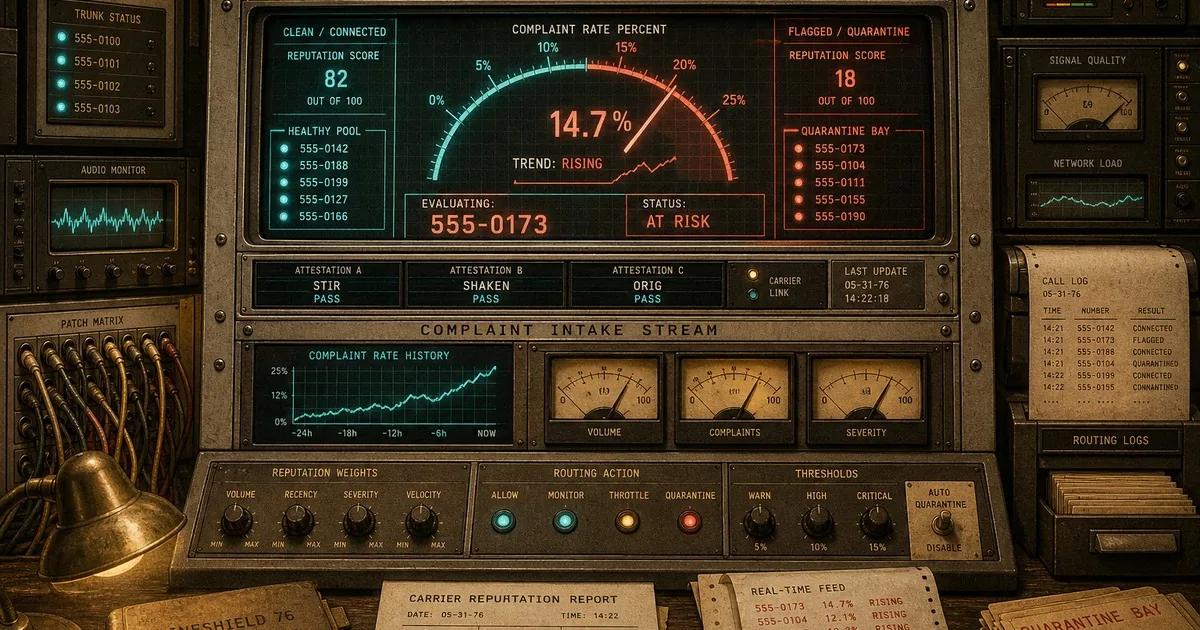
Producers cannot see the score your number carries, but they feel it in the connect rate. When a recipient taps Report Spam, that action does not vanish. It feeds a reputation engine that decides whether your next hundred dials ring clean or carry a Spam Likely label. Understanding complaint rate specifically is the difference between a dialer that connects and one that burns leads.
TL;DR
Complaint rate is the highest-leverage input to phone reputation scoring. Carriers and analytics vendors convert each spam report into a complaint that lowers a number's score, and they do not wait for a high count. A handful of complaints on a high-velocity number trips the threshold fast because the ratio, not the raw total, is what matters. You lower the rate by scrubbing lists, controlling volume, and keeping one identity per number.
Key Takeaways
- Hiya flagged 13.7 billion suspected spam calls in one quarter, and every report feeds its scoring engine.
- Complaint rate is a ratio against call volume, so a few reports on a fresh high-volume number flag it fast.
- One consistent CNAM identity and controlled daily dials lower the complaint ratio measurably.
- Remediation works only after the behavior that generated the complaints is fixed.
What exactly counts as a complaint against your number?
A complaint is any action a recipient takes to report your call as unwanted. It can be a Report Spam tap, a carrier app flag, or a Do Not Call filing with the government. The National Do Not Call Registry is the public side of that feedback loop. Every one of those signals is ingested by the analytics vendors that score outbound numbers.
Why is complaint rate weighted so heavily in the score?
Complaint rate is the clearest consumer signal a scoring engine can read. CallLogic names it first among seven factors that drive reputation. The others are velocity spikes, low answer rates, short durations, off-hours dialing, mixed use cases, and CNAM mismatches. A complaint is a recipient actively telling the network the call was unwanted. TNS survey data shows 43 percent of respondents filed a robocall complaint in the last year.
How does the ratio of complaints to volume change the math?
The threshold is a ratio, not a raw total. A number dialing 200 calls a day with two complaints looks worse than a number dialing 40 calls a day with the same two reports. The complaint per connect is higher. High calls-per-second dialing accelerates flagging because the same complaint count arrives against a compressed volume window. Operators who watch complaints divided by connects catch the drift early, rather than waiting for a raw total.
What does a single complaint actually cost you?
One complaint is never just one complaint. It compounds inside an engine that holds a rolling window of your number's behavior, so a flagged number can stay labeled for days or weeks. Hiya's State of the Call shows 80 percent of unidentified calls now go unanswered. A label does not reduce your answer rate by a little. It can cut most of your connects.
Which behaviors drive the complaint rate up fastest?
Three behaviors dominate. First, dialing numbers on the Register without consent generates complaints that are also violations, so they cost double. Second, velocity spikes where one number suddenly places hundreds of dials look like an autodialer to any scoring engine. Third, a missing or mismatched CNAM identity makes recipients report a number they cannot recognize. Controlling all three separates a clean pool from a burning one, which is the core of our spam flagging guide.
How can an agency lower its complaint rate today?
Start with the list. Scrub against the Registry before every session and honor revocations immediately. Flatten the volume curve so no single number spikes past a controlled daily ceiling. Register a stored CNAM brand through branded calling so your number shows a real business name. Recognition cuts confusion-driven reports.
What does compliant dialing protect beyond the label?
Full STIR/SHAKEN attestation anchors your identity at the carrier level, which supports delivery and label trust. The call authentication framework sits on the same government side as the National Do Not Call Registry. When attestation is intact and complaint rate is low, you are on the right side of a system that penalizes bad behavior and bad hygiene. That is both the liability cover Dave wants and the connect-rate engine Tyler is funding. See the full scoring model explanation.
Sources cited in this analysis?
The claims in this post draw on Hiya's Global Call Threat Report and State of the Call, the TNS Half Year 2025 Robocall Investigation Report, and CallLogic's reputation scoring guidance. Twilio's branded calling documentation, the National Do Not Call Registry, and the FCC call authentication framework round out the source set. Each is cited inline where it supports a specific claim.
Frequently Asked Questions
How many complaints does it take to flag a number?
There is no fixed public threshold. Vendors score numbers on a rolling ratio of complaints to call volume, so a low number of complaints on a high-velocity fresh number can tip it fast. The signal is behavioral, not a hard count, which is why sudden volume spikes flag sooner than steady low-volume dialing.
Does a spam label disappear on its own?
Yes, but slowly. A label ages off only after the complaint window rolls over and your observed behavior normalizes. While it sits, answer rates stay depressed, so waiting is not a strategy. Rest the number, fix the volume and list behavior, then warm it back gradually instead of redialing at full speed.
Can registering CNAM actually lower my complaint rate?
Registering a stored CNAM brand helps recipients recognize your number as a business, which reduces confusion-driven Report Spam taps before the complaint happens. It is one lever among several, not a fix by itself. Combine it with list scrubbing and volume control for a measurable drop in complaint ratio per number.
Is complaint rate the same thing as the Do Not Call Registry?
They are related but separate. The Registry is a government list of numbers consumers do not want called, and dialing them produces both a complaint and a potential violation. Complaint rate is the broader signal analytics vendors compute from every report source. Both feed the reputation picture, but only the Registry carries statutory liability.
LineShield is operated by licensed P&C insurance agency owners, serving captive and independent agents across the U.S. Read more about our team.
How we review: every guide is drafted from carrier and analytics-partner documentation, then fact-checked against live dialer data, because reputation rules shift constantly. Additionally, we re-verify each guide when carrier behavior changes.
Corrections: if you spot an error, contact us at customerservice@theidudes.com and we will fix it promptly.