
How Many DIDs Does Your Insurance Agency Dialer Need?
Calculate the right DID pool size for your insurance agency dialer. Learn the formula accounting for dial volume, carrier velocity limits, and rotation cycles.
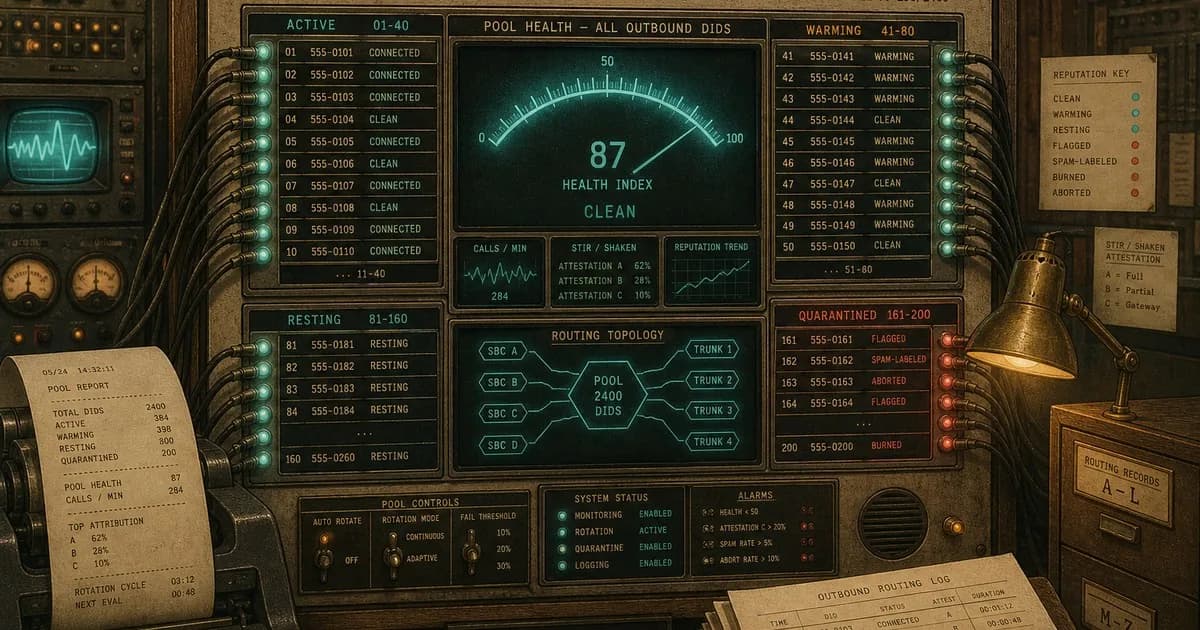
An insurance agency dialer needs one active DID per 75 to 100 daily outbound calls, plus 30 to 50 percent overhead for numbers in warm-up or rest rotation. A five-producer shop dialing 300 calls per producer per day needs between 20 and 30 total DIDs to stay under carrier spam thresholds. Getting the pool size wrong does not just cost you answer rate, it burns through your entire number inventory. Here is the formula, the math, and the operational rhythm that keeps your pool healthy.
TL;DR
Every outbound DID has a velocity ceiling. Push more than 100 calls per number per day through it and carrier analytics engines start scoring it as probable spam. The right pool size is not a guess. It is a calculation: total daily dials divided by the per-DID safe ceiling, plus overhead for warm-up, rest rotation, and a small quarantine buffer. Most P&C agencies run too few DIDs and replace flagged numbers reactively.
That reactive approach is more expensive than sizing the pool correctly from day one. This post gives you the formula, worked examples for three agency sizes, and the management rhythm that catches reputation drift before your producers see the label.
What happens when an agency runs too few DIDs on a dialer?
Agency owners learn this lesson the hard way, usually on a Monday morning after a heavy dialing week. Every number in the pool shows Spam Likely. Answer rate drops from 12 percent to 4 percent overnight. The dialer is still running, but nobody is picking up.
Carrier spam detection watches calling patterns, not scripts. When a single DID pushes 300 calls per day through it, the analytics engines flag it as high-probability telemarketing. The Convoso outbound guide confirms that carriers use proprietary algorithms that factor in call volume spikes, short call durations, high early-hangup rates, and consumer spam complaints Convoso, "Phone Number Marked as Spam". A single number taking the full daily dial volume of a producer reads to these systems exactly like an autodialer running a robocall campaign.
The damage compounds because reputation follows behavioral clusters, not just individual numbers. When three producers share two DIDs on the same carrier sub-account, all three numbers share a reputation pool. One flagged number drags the other two down with it. The TNS 2026 Robocall Investigation Report found that 85 percent of voice traffic between Tier-1 carriers was signed with STIR/SHAKEN protocols in 2025, with 93 percent at the highest A-level attestation TNS, "2026 Robocall Investigation Report". A number without proper attestation or with degraded behavioral history stands out immediately against that authenticated baseline.
How many calls per DID per day keeps you under carrier spam thresholds?
The industry consensus for a safe daily ceiling sits between 75 and 100 outbound calls per DID. SkipCall's analysis identifies 200 to 250 dials per day as the threshold above which carrier algorithms auto-label as spam, and recommends capping each number at 200 dials per day with rotation across multiple numbers SkipCall, "Why Is My Business Number Marked Spam". That 200 number is the ceiling. The safe operating range, where you stay well below the triggering pattern, is 75 to 100 calls per DID per day.
Why the gap between 100 and 200? Because carrier analytics are continuous, not binary. A number running at 180 calls per day is not flagged on day one. It is scored into a degrading reputation over days or weeks. By the time the Spam Likely label appears, the number has been drifting for days.
The second-order signals (short calls, hangups within six seconds, unanswered calls to voicemail) have already compounded by then. Staying at 75 to 100 calls per DID per day gives you a margin that absorbs natural variation without poking the scoring engine.
What happens above the ceiling?
A number exceeding 200 calls per day triggers automated review. At 250 calls per day, the labeling is nearly certain within one to two weeks. SkipCall reports that recovery from a flagged state takes two to four weeks of complete rest SkipCall, "Why Is My Business Number Marked Spam". That is a number that cannot produce for a month. If your pool does not have enough DIDs to rotate flagged numbers into rest while keeping active numbers under the ceiling, you run out of clean numbers fast.
How do you calculate the right DID pool size for your agency?
The pool-sizing formula has three variables: active DIDs, rotation overhead, and a quarantine buffer. Here is the step-by-step calculation.
How do you calculate the active DID count?
Active DIDs equals total daily outbound dials divided by safe calls per DID per day. Use 90 as the per-DID ceiling for conservative planning. A producer dialing 300 calls per day needs 300 divided by 90, which rounds up to 4 active DIDs. If that producer runs a parallel dialer with higher throughput, say 500 calls per day, the math is 500 divided by 90, which rounds up to 6 active DIDs per producer.
How much rotation overhead should you add?
Rotation overhead accounts for DIDs that are not actively dialing because they are warming up, resting between cycles, or in remediation. A healthy rotation cycle uses 30 to 50 percent overhead above the active count. A conservative agency running a 50 percent overhead adds half the active count as spare DIDs.
For one producer with 4 active DIDs, rotation overhead adds 2 DIDs. Total per producer: 6 DIDs.
What quarantine buffer protects against unexpected flags?
The quarantine buffer is one to two DIDs per producer held in reserve for numbers that get flagged unexpectedly and must be pulled immediately. Two DIDs per producer inserted into this buffer is the safe standard.
What does pool sizing look like for different agency sizes?
Small shop (2 producers, 250 calls per producer per day)
- Total daily dials: 500
- Active DIDs: 500 / 90 = 6 (round up)
- Rotation overhead (40%): 3
- Quarantine buffer: 4 (2 per producer)
- Total pool: 13 DIDs
Mid-size shop (5 producers, 300 calls per producer per day)
- Total daily dials: 1,500
- Active DIDs: 1,500 / 90 = 17 (round up)
- Rotation overhead (40%): 7
- Quarantine buffer: 10 (2 per producer)
- Total pool: 34 DIDs
Large shop (15 producers, 350 calls per producer per day)
- Total daily dials: 5,250
- Active DIDs: 5,250 / 90 = 59 (round up)
- Rotation overhead (40%): 24
- Quarantine buffer: 30 (2 per producer)
- Total pool: 113 DIDs
The mid-size shop is the most common LineShield profile: five to seven producers running a captive-leaning book with heavy dialer outbound. At 34 total DIDs, the monthly carrier cost, assuming SIP trunk DIDs at roughly 1 dollar per number per month, sits around 34 dollars per month in raw number cost. That is tiny compared to the cost of a pool-wide Spam Likely event, which the Spam Likely cost analysis pegs at thousands of dollars per month in lost connections. The real cost of pool sizing is not the numbers. It is the monitoring and rotation discipline.
What is the formula for DID pool sizing with rotation?
The formula collapses to one line. Plug in your agency numbers and round every division up.
Total DIDs = (Total Daily Dials / 90) x (1 + Rotation Overhead %) + (Producers x 2)
- Total Daily Dials = sum of all producer daily dials
- 90 = safe calls per DID per day ceiling
- Rotation Overhead = 0.30 to 0.50 (30 to 50 percent)
- Producers x 2 = quarantine buffer (2 per producer)
The formula errs on the side of too many DIDs, which is safer than too few. A DID sitting idle costs roughly a dollar a month. A flag costs you weeks of answer rate on one of your active numbers.
How do warm-up and rest cycles change the pool-size math?
The rotation overhead in the formula is not dead weight. Those DIDs are working. They are warming up for next-week deployment or resting between active cycles.
How does the warm-up cycle affect pool capacity?
A new DID cannot go from zero to 90 calls on day one. It needs a graduated warm-up schedule. The DID warm-up guide covers the full protocol: start at 20 to 30 calls per day, increase by 10 to 15 calls per day each subsequent day, and reach full volume after roughly one week.
During warm-up, a DID that will eventually carry 90 calls per day is only carrying an average of 55 calls per day across its first week. Your active pool needs extra DIDs to absorb that capacity gap. The rotation overhead percentage in the formula accounts for this.
How long should a DID rest between active cycles?
A DID that has been running at 90 calls per day for two weeks needs a rest period to cool its reputation signals. The rest protocol in the DID rotation guide recommends a 5-to-7-day rest at roughly one-third volume or complete silence. While that number rests, another number from the overhead pool rotates into its slot. The overhead percentage in the formula covers this replacement capacity.
What rhythm keeps a DID pool healthy over time?
A healthy pool cycles each DID through three states: warm-up (5 to 7 days), active (10 to 14 days), rest (5 to 7 days). At any given time, roughly one-third of your pool is in warm-up or rest. That is the 30 to 50 percent overhead in the formula. Agencies that skip the rest cycle see DIDs degrade into Spam Likely within 30 days of continuous high-volume dialing.
What does DID pool management cost per producer per month?
The numbers themselves are cheap. SIP trunk DIDs from Twilio, Bandwidth, or Plivo cost 1 to 2 dollars per number per month. A 34-DID pool for a five-producer shop costs 34 to 68 dollars per month in raw number cost.
The real cost is in monitoring and rotation management. Manual monitoring, where a manager pulls reports weekly and checks each DID against Hiya, TNS, and First Orion, takes roughly 60 to 90 minutes per week for a mid-size pool. At a loaded cost of 30 to 40 dollars per hour, that is 120 to 240 dollars per month in labor. Automated monitoring through a reputation management platform adds another 50 to 150 dollars per month depending on pool size and feature set.
Total monthly cost for a five-producer operation: roughly 200 to 450 dollars all-in. Compare that to the cost of a pool-wide Spam Likely event, where five producers lose 50 to 60 percent of their answer rate for two weeks. At an average commission of 400 dollars per policy and a conversion rate of 2 percent on answered calls, a two-week answer-rate collapse costs the agency roughly 4,800 to 7,200 dollars in lost new business. The pool management cost is roughly 5 to 10 percent of the cost of getting flagged.
How do you monitor pool health so you spot problems before flags hit?
Pool health monitoring has three layers. Daily velocity tracking catches volume spikes the same day. Weekly cross-carrier checks spot early reputation drift before labels appear. Monthly full-audit cycles retire chronically degraded DIDs and refresh the quarantine buffer.
What does daily velocity tracking catch?
Pull a simple report from your dialer at the end of each day: calls per DID, average call duration, and early hangup rate (calls under 6 seconds divided by total calls). Any DID exceeding 100 calls in a day or showing an early hangup rate above 25 percent gets flagged for review. The carrier velocity limits guide covers the full signal set that carrier analytics engines track.
How do weekly cross-carrier checks spot early drift?
Once a week, run every active DID through the Free Caller Registry at freecallerregistry.com. This queries Hiya, TNS, and First Orion in a single submission. A DID that shows clean on two networks but flagged on the third is in early-stage reputation drift. Pull it into remediation at reduced volume before it spreads to all three networks. The remediation playbook is covered in the spam flagged number fix guide.
What belongs in a monthly pool audit?
Once a month, do a complete pool audit. Retire any DID that has been flagged on two or more networks for more than two weeks. Replace it from your quarantine buffer. Bring a replacement DID into warm-up to refill the buffer. The quarterly DID maintenance guide covers the full audit checklist, and the monthly cadence adapts it to a more frequent rhythm for active pools.
The FCC's July 2026 Further Notice of Proposed Rulemaking proposes codifying STIR/SHAKEN attestation levels into regulation and defining improper attestation as a violation FCC, "KYUP FNPRM," July 2026. When attestation becomes a regulatory requirement rather than a best practice, the cost of running a sloppy pool goes from lost answer rate to potential enforcement exposure. Pool health monitoring is no longer optional.
Sources cited in this analysis?
- Hiya, "2026 State of the Call" -- 86% of unknown calls go unanswered in 2026.
- TNS, "2026 Robocall Investigation Report" -- 85% of Tier-1 carrier traffic STIR/SHAKEN signed, 93% at A-level attestation.
- YouMail, "Robocall Index -- June 2026" -- 4.3 billion robocalls placed nationwide in June 2026.
- Convoso, "Phone Number Marked as Spam? Causes, Fixes and Ways to Improve Contact Rates" -- Carrier spam detection signals and reputation management practices.
- SkipCall, "Why Is My Business Number Marked Spam? (Free Fix)" -- 200 to 250 dials per day as the spam-label threshold, 2 to 4 week recovery period.
- FCC, "Enhancing Know-Your-Upstream-Provider Requirements and Strengthening STIR/SHAKEN," FCC Fact Sheet, July 2026 -- Proposed FCC rules codifying attestation levels and defining improper attestation.
Frequently Asked Questions
How many phone numbers does a single insurance producer need on a dialer?
A single insurance producer dialing 300 outbound calls per day needs 4 active DIDs using the 90-calls-per-DID safe ceiling. Add rotation overhead of 2 DIDs and a quarantine buffer of 2 DIDs. Total: 8 DIDs per producer. If the producer runs a parallel dialer pushing 500 calls per day, increase to 6 active, 3 overhead, 2 quarantine. Total: 11 DIDs.
What happens if I run more than 100 calls per day through one phone number?
Running more than 100 calls through a single DID puts it in the watch zone. Carrier analytics engines score calling patterns continuously. A number at 150 daily calls degrades its reputation score over one to two weeks before the Spam Likely label appears. Callers see reduced answer rates days before the label surfaces.
Can I just buy more numbers when mine get flagged instead of sizing a pool?
A burn-and-churn approach costs more than proper pool sizing. New DIDs with no call history look suspicious to carrier analytics when they suddenly blast at full volume. They need a warm-up week before carrying their share. A reactive approach keeps your pool in permanent warm-up mode with half your capacity idle. The formula costs less and produces more connectable hours.
How much does a properly sized DID pool cost per month?
A five-producer 34-DID pool costs 34 to 68 dollars per month in raw carrier charges. Monitoring labor adds 120 to 240 dollars. Automated reputation tools add 50 to 150 dollars. Total: 200 to 450 dollars per month. A single pool-wide Spam Likely event costs 4,800 to 7,200 dollars in lost new business over two weeks.
How often should I check my DID pool health?
Check daily for velocity violations (calls per DID, early hangup rate). Check weekly for cross-carrier flags using the Free Caller Registry. Run a full monthly audit that retires chronically flagged DIDs. The daily check takes five minutes, the weekly check fifteen minutes, and the monthly audit an hour.
LineShield is operated by licensed P&C insurance agency owners, serving captive and independent agents across the U.S. Read more about our team.
How we review: every guide is drafted from carrier and analytics-partner documentation, then fact-checked against live dialer data, because reputation rules shift constantly. Additionally, we re-verify each guide when carrier behavior changes.
Corrections: if you spot an error, contact us at customerservice@theidudes.com and we will fix it promptly.